Wells Fargo
WFC
NGP Capital
Santander
BNP Paribas
0HB5
Royal Bank of Canada
Société Générale
Industrial And Commercial Bank Of China Limited
Regions Bank
The financing gives Aypa a stable capital base to accelerate large‑scale storage deployment, a linchpin for grid reliability and renewable integration, while signaling robust investor confidence in the expanding U.S. BESS sector.
The U.S. battery energy storage market has entered a phase where capital availability is as decisive as technology choice. Warehouse lending, traditionally used for mortgage origination, is now being repurposed to supply rapid, flexible financing for infrastructure projects. By securing a $1.5 billion revolving line, Aypa Power taps into this liquidity pool, positioning itself to meet the surge in utility‑scale storage demand driven by state mandates and renewable‑integration targets.
Aypa’s facility stands out not only for its size but also for the built‑in $500 million accordion feature, which pre‑sets terms for future drawdowns without renegotiation. This structure reduces execution risk and accelerates project timelines, allowing Aypa to lock in favorable rates while the market remains volatile. The credit line will underwrite projects through 2028, including a flagship 300 MW/1,200 MWh system in South Carolina that will employ lithium‑iron‑phosphate cells—an increasingly popular chemistry for its safety and longevity.
The broader financing landscape reflects a growing appetite among banks and institutional investors for green‑loan products tied to clean‑energy assets. Aypa’s multi‑bank syndicate, featuring names like CIBC, Wells Fargo, and BNP Paribas, signals confidence that storage will become a core revenue stream for power producers. Parallel moves, such as Liminal Energy’s $200 million capital raise, illustrate that both established and emerging developers are leveraging diverse capital sources to capture market share in a sector projected to exceed 30 GW of installed capacity by 2030.
By April Bonner · February 5, 2026
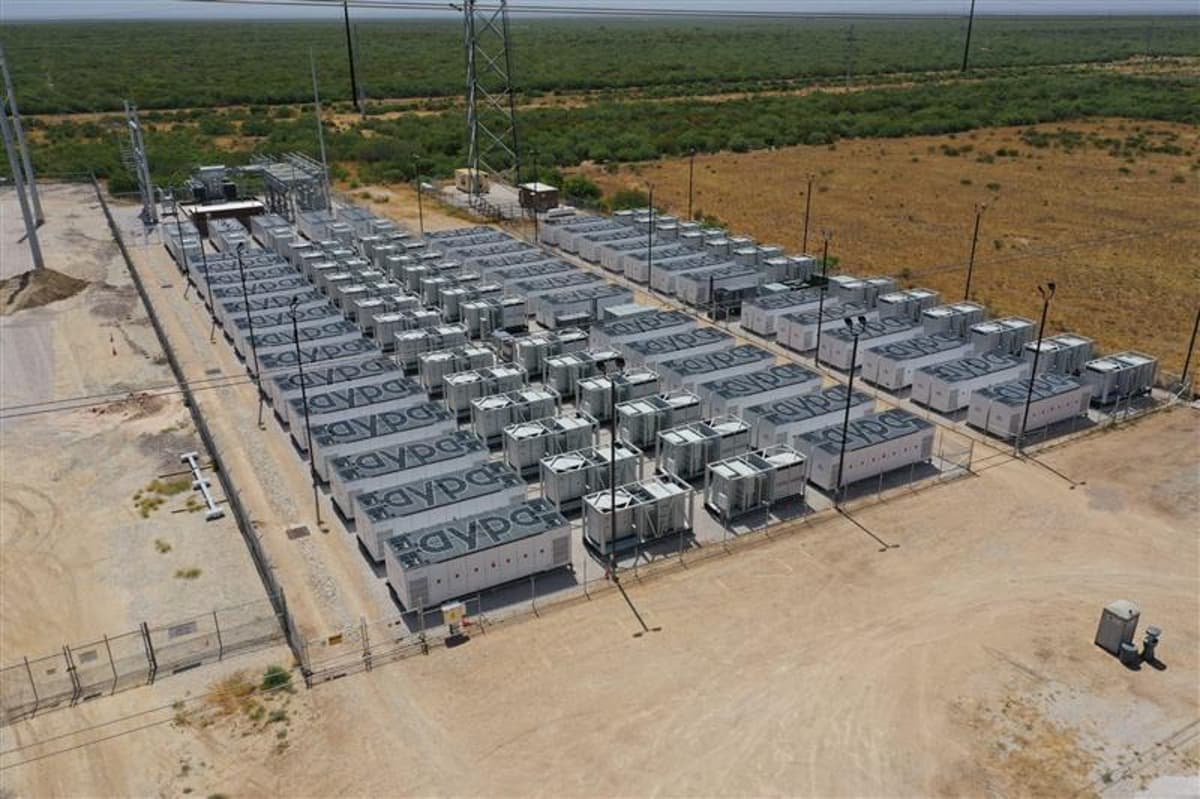
Energy storage developer‑operator Aypa Power has closed a US$1.5 billion construction‑warehouse revolving credit facility to advance projects across the United States.
The credit facility features an extra US$500 million “accordion” option. Aypa Power describes it as a “first‑of‑its‑kind transaction” and the largest warehouse financing for a storage‑focused independent power producer (IPP). The facility will be the company’s main funding source for projects expected to become operational through 2028.
Warehouse lending typically offers loan originators a credit line to finance mortgages, enabling banks to issue loans without tying up their capital. After a loan is originated, it is sold in the secondary market to cover the credit. This short‑term credit system helps banks stay liquid while earning from origination fees and loan sales.
An accordion feature is an option allowing a company to expand its line of credit with a lender. If the company needs to borrow additional funds later, the terms are pre‑established by this feature and do not require renegotiation.
In May 2025, Aypa obtained a US$1.05 billion credit facility, increasing its existing corporate credit line from July 2024 to speed up pipeline deployment.
In December, South Carolina public utility Santee Cooper submitted an application to the state’s public service commission for a Certificate of Environmental Compatibility and Public Convenience and Necessity (CECPCN) to approve a 300 MW/1,200 MWh battery energy storage system (BESS). Aypa will use lithium‑iron‑phosphate (LFP) battery cells at the project, which will be located at the retired Jefferies generating station in South Carolina. Aypa was chosen to develop the BESS in response to Santee Cooper’s 2025 request for proposals (RFP) calling for BESS submissions.
A broad network of financial institutions participated in the US$1.5 billion credit facility. Canadian Imperial Bank of Commerce (CIBC), New York Branch, and Wells Fargo served as lead structuring agents, lead arrangers, coordinating lead arrangers, and green‑loan coordinators. CIBC New York acted as the administrative and collateral agent for the three‑year facility. US Bank National Association was the depositary agent. Banco Santander, BNP Paribas, ING Capital, Natixis, Royal Bank of Canada, and Société Générale also took on roles as coordinating lead arrangers. ING Capital additionally acted as green‑loan coordinator. The joint lead arrangers included Bank of America, N.A., Fédération des Caisses Desjardins du Québec, Industrial and Commercial Bank of China Limited, New York Branch, KeyBanc Capital Markets, National Bank of Canada, PNC Capital Markets, Standard Chartered Bank, US Bank National Association, and Zions Bancorporation, N.A. Regions Bank served as a mandated lead arranger.
Ines Serrao, Managing Director and Co‑Head of US Project Finance & Infrastructure at CIBC, noted, “The facility is structured to support a portfolio of construction‑ready, utility‑scale assets and highlights the strength of Aypa Power’s development discipline.”
In related news, energy‑storage project developer Liminal Energy recently secured capital commitments from private‑equity investor NGP alongside contributions from Liminal’s management team. The company confirmed that the amount it secured was US$200 million.
Liminal describes itself as a newly established developer, operator, and investor specialising in utility‑scale energy‑storage projects. Its team comprises executives who have developed, financed, and operated more than 3 GWh of energy storage, previously working at firms such as Goldman Sachs Asset Management, National Grid Renewables, UBS Asset Management, and MN8 Energy. Liminal collaborates with developers and capital providers to develop, operate, and own large‑scale energy‑storage solutions.
Market‑research firm Voltility reported that Mark Saunders, Co‑Founder of Liminal and former Co‑Head of Energy Storage at UBS Asset Management and head of the energy‑storage team at Goldman Sachs Renewable Power (GSRP), said the company aims to quickly deploy capital, mainly focusing on energy storage.
Comments
Want to join the conversation?
Loading comments...