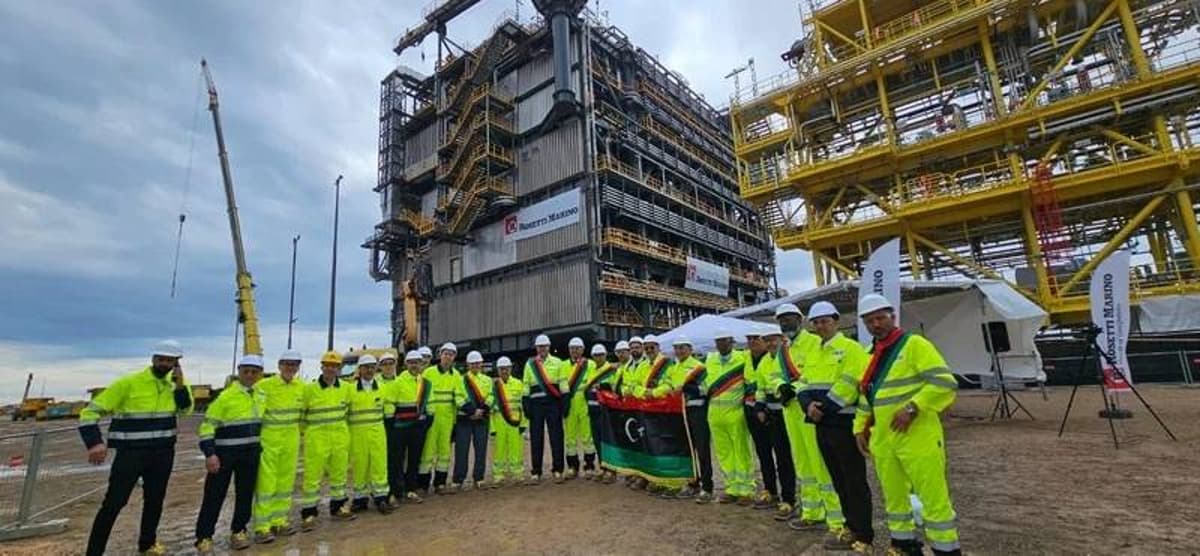
Bouri Gas Project Modules Sail for Installation Offshore Libya
Companies Mentioned
Why It Matters
The project will boost Libya’s gas output, diversify its export portfolio, and showcase a low‑emission offshore model that could attract further foreign investment. Its timely delivery also strengthens strategic energy ties between Europe and North Africa.
Key Takeaways
- •Bouri project 69% complete, ahead of 62% target.
- •Production slated for September 2026, 125 MMcf/d capacity.
- •Modules en route, arrival in 10 days for platform tie‑in.
- •$1.565 bn contract, $928 mn spent by Dec 2025.
- •Zero‑flaring design supports Libya’s emission goals.
Pulse Analysis
Libya’s Bouri Gas Utilization Project marks a pivotal shift in the country’s energy landscape, positioning it as a reliable gas supplier to Europe amid ongoing geopolitical tensions. By leveraging a joint venture between the state‑run National Oil Corporation and Italy’s Eni, the development combines local resource control with European technical expertise. The project’s 125 million cubic feet per day capacity will not only meet domestic demand but also feed the growing European market seeking cleaner‑burning fuels, reducing reliance on more carbon‑intensive hydrocarbons.
The engineering and construction phase, led by Saipem, has progressed faster than scheduled, with 69% of the work completed versus a 62% benchmark. This acceleration reflects strong project governance and the strategic importance placed on meeting the September 2026 production target. The installation of two subsea pipelines—a 14‑inch, 8‑km link between platforms and a 10‑inch, 20‑km line to the Sabratha hub—underscores the project's emphasis on robust infrastructure, ensuring efficient gas transport to the Mellitah industrial complex and downstream markets.
From an environmental standpoint, the zero‑flaring design aligns with global decarbonization trends and Libya’s own emission reduction commitments. By eliminating routine flaring, the Bouri field sets a benchmark for future offshore developments in the region. The substantial capital outlay—$1.565 billion, with $928 million already expended—signals confidence from international partners and could catalyze additional foreign direct investment in North Africa’s energy sector, reinforcing the continent’s role in the evolving global energy transition.
Bouri Gas Project Modules Sail for Installation Offshore Libya
Comments
Want to join the conversation?
Loading comments...