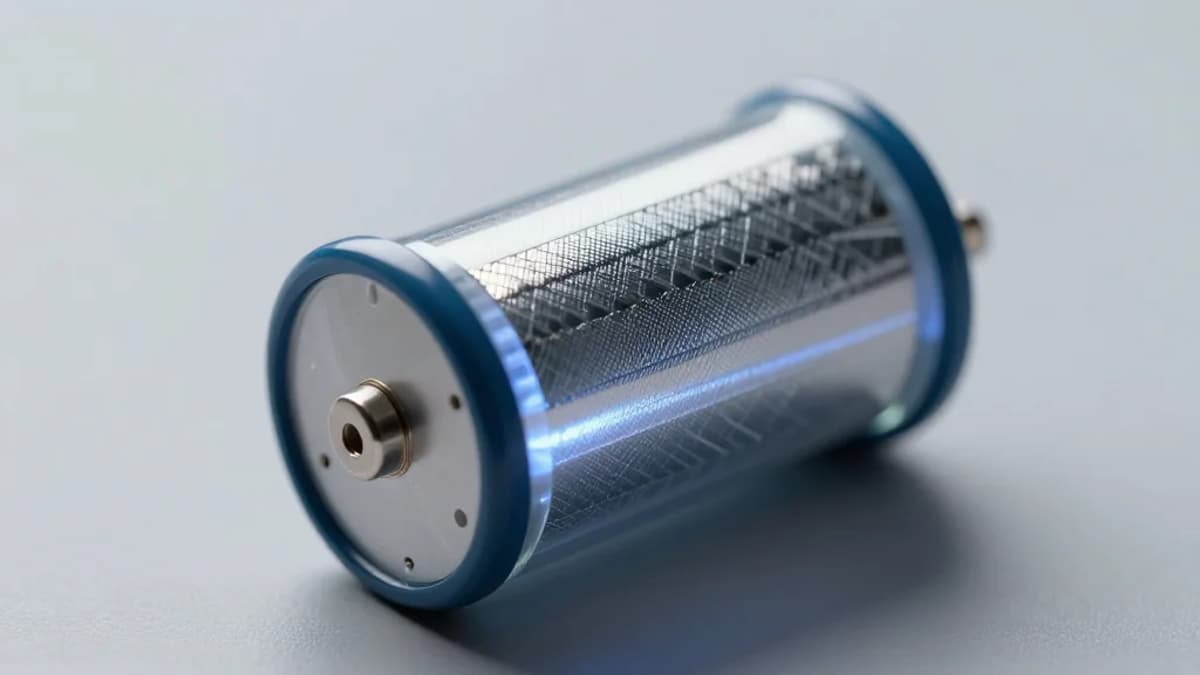
Carbon-Ion Energy Explores Graphene Integration in Its Supercapacitors
•March 5, 2026
0
Why It Matters
If successful, graphene‑enhanced supercapacitors could deliver higher power density and faster charge rates, strengthening Carbon‑Ion’s position in the growing energy‑storage market. The partnership also signals rising demand for high‑purity graphene in commercial applications.
Key Takeaways
- •Carbon‑Ion partners with Levidian and HydroGraph.
- •Suppliers provide ultra‑pure graphene (≈99.9% purity).
- •Graphene aims to improve ion transport, energy efficiency.
- •ZapStart UPS updates slated for Q1 2026.
- •Project remains exploratory; no guaranteed timeline.
Pulse Analysis
Supercapacitors sit at the intersection of batteries and traditional capacitors, offering rapid charge‑discharge cycles and long lifespans. As renewable energy and electric mobility demand ever‑faster energy bursts, manufacturers are hunting materials that can shrink internal resistance while preserving high energy density. Graphene, with its atomically thin lattice and exceptional conductivity, has long been touted as a game‑changer, yet commercial adoption has been hampered by inconsistent quality and integration challenges.
Carbon‑Ion’s renewed focus on graphene comes with two specialized suppliers—Levidian and HydroGraph—known for combustion‑based production that yields graphene purities above 99.8%. Such consistency is critical for tailoring inter‑layer spacing, a key parameter that governs ion mobility within supercapacitor electrodes. By fine‑tuning morphology, the company aims to reduce diffusion barriers, potentially lifting power density and extending cycle life. The collaboration also leverages lessons from earlier graphene trials, allowing a more systematic evaluation of how sheet orientation and defect density affect performance metrics.
Beyond the technical promise, the move signals broader market validation for high‑purity graphene in energy storage. Should Carbon‑Ion demonstrate measurable gains, it could accelerate adoption across grid‑scale UPS systems like its ZapStart line, which is slated for updates in the first quarter of 2026. Investors and industry observers will watch for data releases, as successful integration could reshape competitive dynamics, prompting rivals to pursue similar material strategies and driving up demand for premium graphene supplies.
Carbon-Ion Energy explores graphene integration in its supercapacitors
0
Comments
Want to join the conversation?
Loading comments...