Cellulose Nanofibril Binder Helps Build Cleaner, Higher-Capacity Lithium Batteries
Why It Matters
The breakthrough offers a scalable, PFAS‑free route to higher‑energy batteries while reducing hazardous chemicals, addressing both performance and environmental regulations.
Key Takeaways
- •c‑CNF binder replaces fluorinated PVDF, eliminating PFAS.
- •Enables 113 mg cm⁻² loading and 22.5 mAh cm⁻² areal capacity.
- •Delivers 1781 Wh L⁻¹ volumetric energy density at low rate.
- •Retains ~88 % capacity after 300 cycles, outpacing PVDF.
- •Manufactured with ethylene glycol, removing hazardous NMP solvent.
Pulse Analysis
The battery industry faces mounting pressure to eliminate per‑ and polyfluoroalkyl substances (PFAS) from electrode formulations. Traditional polyvinylidene fluoride (PVDF) binders rely on fluorinated chemistries and N‑methyl‑2‑pyrrolidone (NMP), a solvent linked to health and environmental concerns. As automakers and consumer‑electronics firms push for greener supply chains, researchers are scrambling for alternatives that do not compromise energy density or manufacturability. The emergence of charge‑engineered cellulose nanofibrils (c‑CNF) marks a decisive step toward that goal, marrying renewable feedstocks with molecular‑level surface‑charge design.
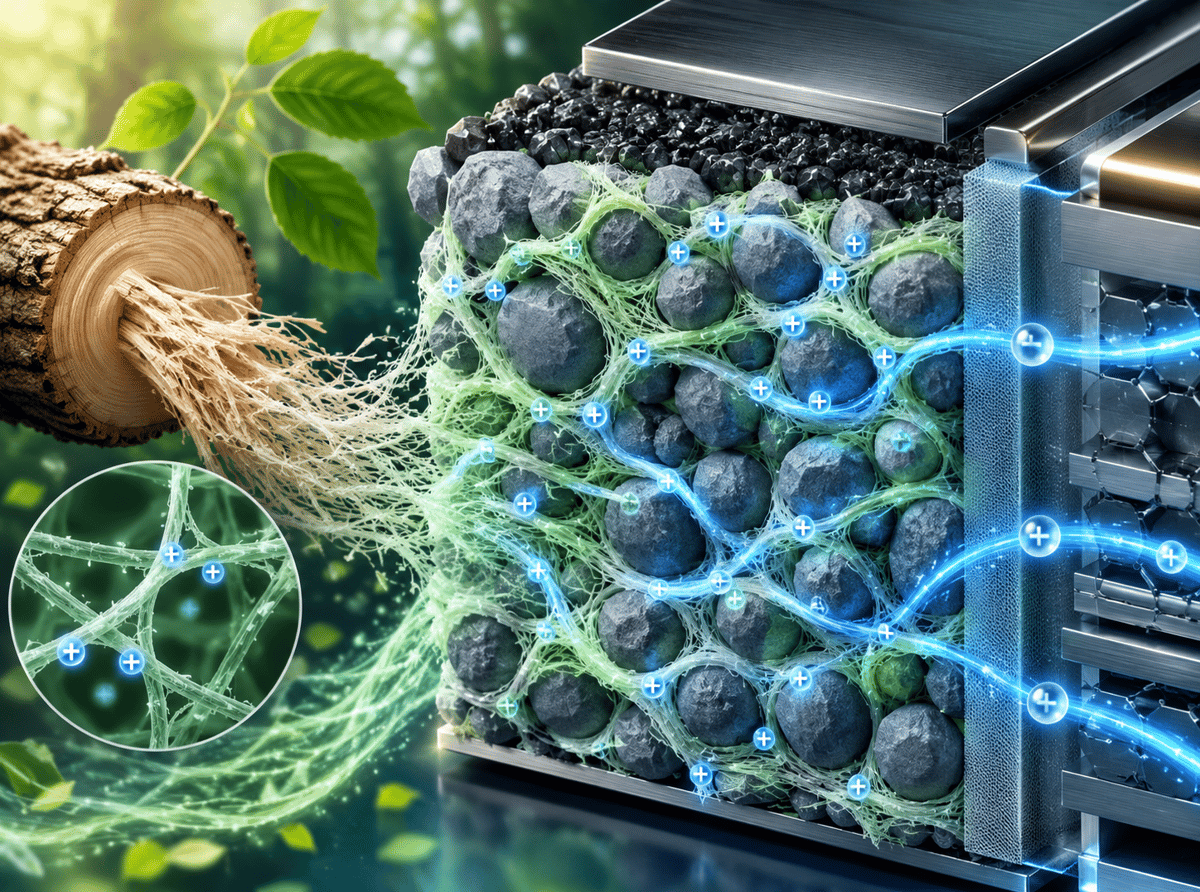
c‑CNF binders achieve their performance edge through two synergistic mechanisms. First, quaternary ammonium groups impart a positive surface charge, creating electrostatic repulsion that stabilizes active‑material slurries and prevents aggregation of conductive additives such as single‑walled carbon nanotubes. Second, the nanofibrous morphology establishes an interconnected hydrogen‑bonded network that reinforces electrode cohesion while opening porous pathways for electrolyte infiltration. The result is a robust, high‑loading cathode—113 mg cm⁻² mass loading and 3.65 g cm⁻³ density—that delivers 22.5 mAh cm⁻² areal capacity and a volumetric energy density of 1,781 Wh L⁻¹ at 0.05 C. Mechanical testing confirms reduced crack propagation, and long‑term cycling retains roughly 88 % of capacity after 300 cycles, a clear advantage over PVDF‑based controls.
From a commercial perspective, c‑CNF’s compatibility with ethylene glycol slurry processing eliminates NMP, cutting both regulatory risk and solvent‑recovery costs. The binder’s roll‑to‑roll‑compatible formulation aligns with existing manufacturing lines, easing adoption for large‑scale cell producers. Higher areal capacities translate directly into fewer stacked layers, lighter packs, and longer driving ranges for electric vehicles—key differentiators in a competitive market. As sustainability mandates tighten and investors prioritize ESG metrics, the c‑CNF platform offers a compelling blend of environmental stewardship and performance, positioning it as a cornerstone technology for next‑generation high‑energy lithium‑ion batteries.
Cellulose Nanofibril Binder Helps Build Cleaner, Higher-Capacity Lithium Batteries
Comments
Want to join the conversation?
Loading comments...