China Added a Germany-Sized Electricity Grid Last Year - OWID
Why It Matters
The unprecedented scale of low‑carbon capacity addition accelerates China’s decarbonisation, reshapes global power markets, and sets a new benchmark for rapid renewable and nuclear deployment.
Key Takeaways
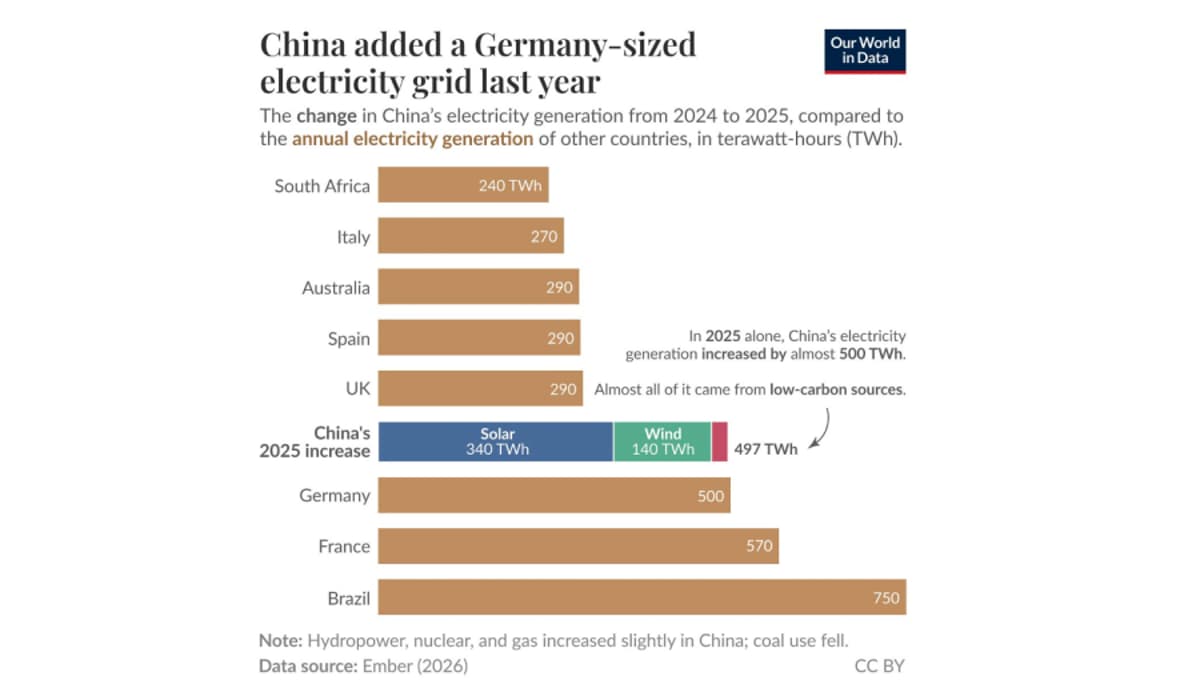
- •China added ~500 TWh of generation in 2025, equal to Germany’s output.
- •Solar and wind supplied 340 TWh extra, outpacing UK and Spain combined.
- •Coal generation fell slightly as renewables surged.
- •World’s largest offshore solar farm powers 2.67 million people.
- •China runs 60 reactors, 36 more under construction, leading global nuclear growth.
Pulse Analysis
China’s 2025 electricity surge underscores a historic shift in global energy dynamics. Adding roughly 500 TWh—comparable to Germany’s entire annual output—demonstrates the country’s ability to scale generation at a pace few economies can match. This expansion is not merely a numeric milestone; it reflects a strategic pivot toward low‑carbon sources that could influence commodity prices, grid stability standards, and international climate commitments. Investors and policymakers now watch China’s grid as a bellwether for the feasibility of large‑scale clean‑energy transitions.
Renewables drove the bulk of the growth, with solar and wind accounting for the majority of new capacity. Solar alone contributed an additional 340 TWh, eclipsing the total generation of the United Kingdom and Spain combined. The launch of the world’s largest offshore solar farm—2.3 million panels spread across 2,934 platforms—illustrates China’s engineering ambition and its focus on diversifying generation assets. As a result, coal’s share slipped, marking the first notable decline in a market long dominated by fossil fuels. This renewable surge not only reduces emissions but also creates new supply chains and export opportunities for Chinese manufacturers.
Parallel to its renewable push, China is industrialising nuclear power at an unmatched rate. With 60 reactors already online and 36 under construction, the nation can potentially build 50 reactors simultaneously, turning nuclear development into a manufacturing‑scale operation. This approach lowers costs, shortens timelines, and enhances energy security, providing baseload power to complement intermittent renewables. The rapid nuclear rollout positions China as a global leader, influencing future international standards and potentially reshaping the competitive landscape for nuclear technology providers worldwide.
China added a Germany-sized electricity grid last year - OWID
Comments
Want to join the conversation?
Loading comments...