Chinese Scientists Build Silver-Free Heterojunction Solar Cell with 25.2% Efficiency
Why It Matters
By eliminating silver‑based metallization, the breakthrough cuts material costs and reduces supply‑chain risk while pushing HJT efficiencies toward the theoretical limit, reshaping the economics of next‑generation solar panels.
Key Takeaways
- •Plasma‑treated ITO lifts HJT efficiency to 25.2%
- •Copper electroplating replaces expensive silver pastes
- •Ar/H₂ plasma creates oxygen vacancies and surface hydroxylation
- •Uniform nickel seed layer cuts contact resistance and over‑plating
- •Scalable process already yields >24% efficiency on larger cells
Pulse Analysis
Heterojunction (HJT) silicon solar cells have long been prized for their high open‑circuit voltages and low recombination losses, but their commercial rollout has been hampered by reliance on silver‑based screen‑printed pastes for front‑side metallization. Silver’s price volatility and limited global supply add significant cost and risk to large‑scale manufacturing, prompting researchers to explore copper electroplating as a cheaper alternative. However, copper’s aggressive diffusion and poor adhesion to the transparent conductive oxide (TCO) layer, typically indium tin oxide (ITO), have historically limited its adoption, creating a critical bottleneck for cost‑effective HJT production.
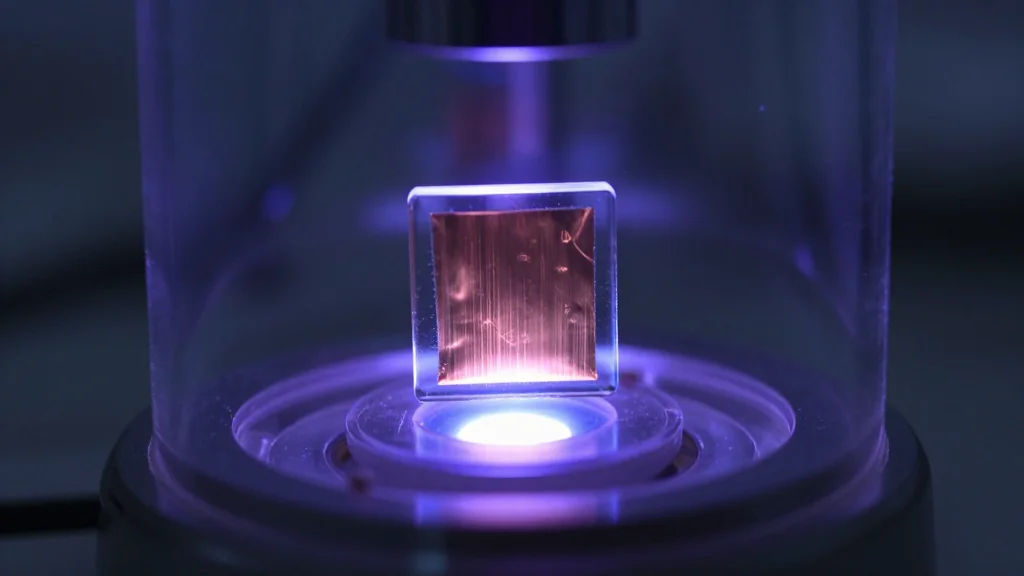
The Nankai University team tackled this bottleneck with an argon‑hydrogen (Ar/H₂) plasma‑induced interface engineering process. By exposing ITO to a controlled plasma, interstitial hydrogen atoms and oxygen vacancies are introduced, while surface hydroxyl groups render the ITO super‑hydrophilic. Density functional theory calculations showed that hydroxylation deepens nickel ion adsorption energy from –0.753 eV to –2.18 eV, facilitating a dense nickel seed layer that acts as both a diffusion barrier and a uniform nucleation platform for copper. Finite‑element simulations confirmed a more even current distribution during electroplating, suppressing localized over‑plating and dramatically lowering contact resistance.
The performance gains are striking: cells fabricated with the plasma‑treated ITO reached 25.2% efficiency, an open‑circuit voltage of 742 mV, and an 83.9% fill factor, outpacing untreated counterparts by over 4 percentage points. Beyond the lab, the technique promises to slash material costs—copper is roughly one‑tenth the price of silver per kilogram—and mitigate supply constraints, accelerating the commercial viability of ultra‑high‑efficiency modules. As the solar industry seeks to meet aggressive cost‑per‑watt targets, this silver‑free, plasma‑engineered approach could become a cornerstone of next‑generation photovoltaic manufacturing.
Chinese scientists build silver-free heterojunction solar cell with 25.2% efficiency
Comments
Want to join the conversation?
Loading comments...