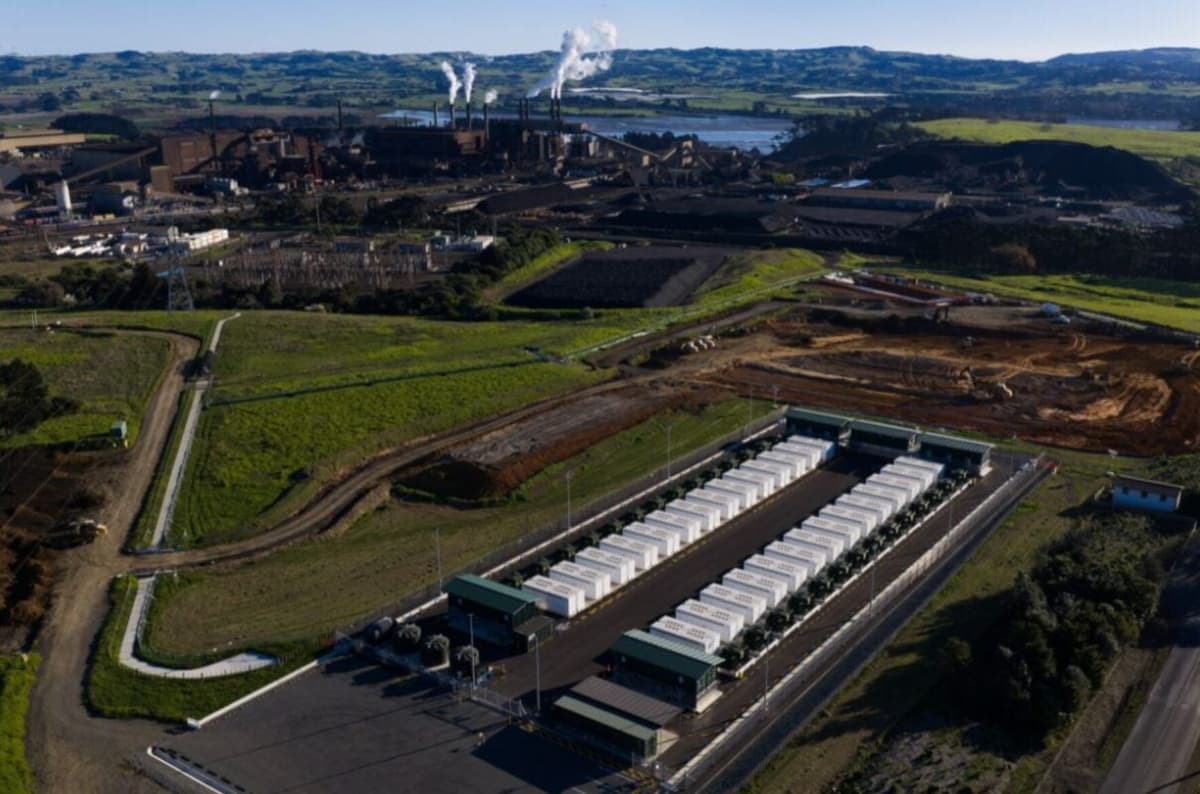
Contact Energy Switches on 200MWh Battery Storage System in New Zealand
Companies Mentioned
Why It Matters
The battery bolsters New Zealand’s grid reliability amid a looming supply gap, accelerating the country’s transition to renewable‑heavy generation. It also signals growing investor confidence in utility‑scale storage as a core component of the nation’s energy mix.
Key Takeaways
- •Contact Energy commissioned 100 MW/200 MWh battery at Glenbrook
- •System uses 56 Tesla Megapack 2XL units, 0.2‑second response
- •Delivered on time, under budget, creating ~50 construction jobs
- •Expansion option to 130 MW makes it NZ’s largest battery storage
- •Part of NZ$525 million equity raise funding solar and geothermal projects
Pulse Analysis
New Zealand’s electricity grid is at a crossroads, with the national operator warning of potential shortfalls by 2031 if new capacity is not added quickly. As the country leans heavily on hydro, geothermal and wind, curtailment of renewable output during low‑demand periods has become a persistent challenge. Large‑scale battery energy storage systems (BESS) like Contact Energy’s Glenbrook installation provide a flexible solution, capturing surplus generation and releasing it when demand spikes, thereby smoothing supply and enhancing grid stability.
The Glenbrook Ohurua Battery 1 marks the first deployment of Tesla’s Megapack 2XL in New Zealand, featuring 56 modular units that can deliver power within 0.2 seconds. With a two‑hour duration, the 100 MW/200 MWh system acts as a rapid‑response “Swiss Army knife,” supporting frequency regulation, peak shaving, and emergency backup. The project’s on‑time, under‑budget delivery—thanks to a consortium that includes ABB, Omexom and Transpower—created roughly 50 jobs during construction and sets a benchmark for future utility‑scale storage contracts.
Strategically, the battery is a cornerstone of Contact Energy’s NZ$525 million equity raise, which also finances a 150 MW solar farm with Lightsource bp and a geothermal expansion at Tauhara 2. An optional upgrade to 130 MW would make the site the nation’s largest storage asset, while a second 200 MW/400 MWh battery slated for 2028 will further cement the company’s leadership in the emerging New Zealand storage market. As more developers announce low‑cost BESS projects, Contact’s early move positions it to capture market share, attract capital, and meet the country’s renewable‑energy targets ahead of schedule.
Contact Energy switches on 200MWh battery storage system in New Zealand
Comments
Want to join the conversation?
Loading comments...