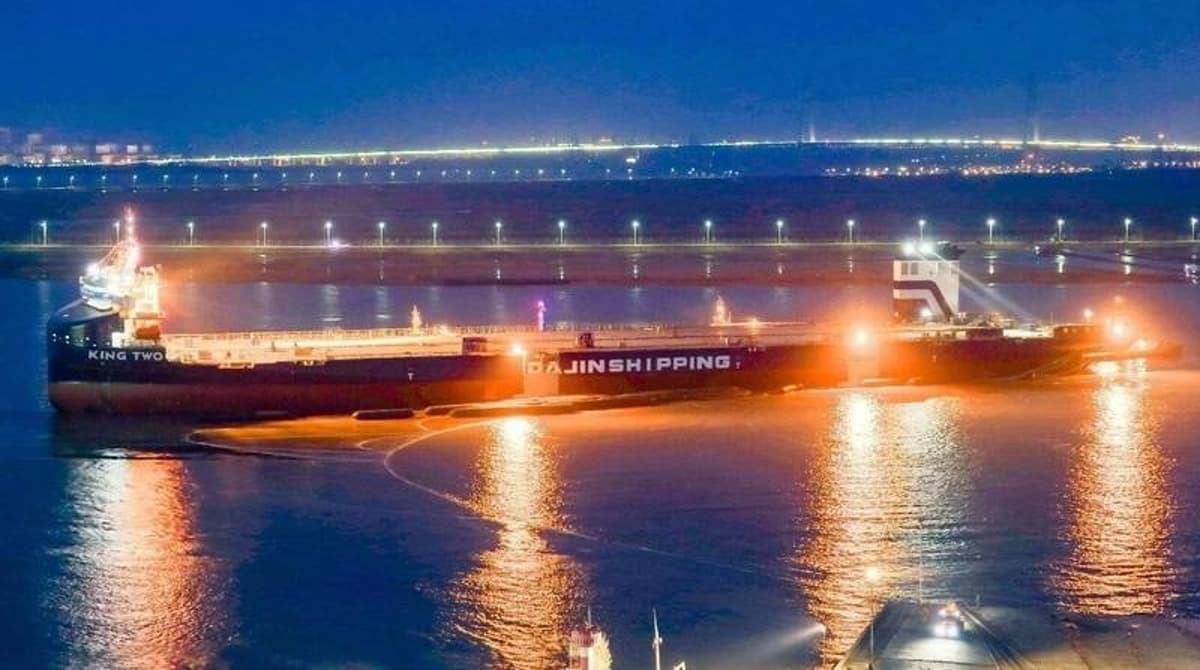
Dajin Expands Offshore Wind Logistics Fleet with KING TWO Launch
Why It Matters
KING TWO expands Dajin’s logistics capacity, enabling faster, longer‑range transport of massive wind turbine parts and strengthening its position in China’s booming offshore wind market. The new capability also helps Dajin capture more EPCI contracts as the sector scales.
Key Takeaways
- •KING TWO adds 40,000 DWT capacity to Dajin's fleet
- •Deck area of 12,000 m² transports 15‑25 MW turbine components
- •Dual-engine design enables 13‑knot speed, 16,000‑nm range
- •Third KING vessel slated for May launch, expanding EPCI services
Pulse Analysis
The offshore wind industry faces a logistics bottleneck as turbine components grow in size and weight. Large deck carriers like Dajin’s KING TWO are essential for moving monopiles, jackets and floating foundations from manufacturing hubs to installation sites. By adding a 40,000‑DWT vessel with a 12,000‑square‑meter deck, Dajin addresses a critical gap in the supply chain, reducing reliance on chartered ships and cutting project lead times.
KING TWO’s technical specifications are tuned to the next generation of wind turbines, which now target 15‑25 MW output. Dual engines and propellers give the carrier a steady 13‑knot cruise, while a 16,000‑nautical‑mile range allows trans‑Pacific voyages without refueling. Compared with older vessels, the new carrier offers higher payload efficiency and better fuel economics, translating into lower transport costs for developers. Its ability to handle oversized modules also supports the growing trend toward floating wind farms, where logistics are even more complex.
Strategically, the launch signals Dajin’s evolution from a pure manufacturer of offshore foundations to a full‑service EPCI provider. With three KING vessels slated for 2026, the company can offer integrated solutions that cover fabrication, marshaling, transportation and installation. This vertical integration aligns with China’s aggressive offshore wind targets—aiming for 50 GW of capacity by 2030—and positions Dajin to win contracts not only domestically but also in emerging markets seeking reliable logistics partners. The fleet expansion thus strengthens Dajin’s competitive edge in a rapidly scaling renewable energy sector.
Dajin Expands Offshore Wind Logistics Fleet with KING TWO Launch
Comments
Want to join the conversation?
Loading comments...