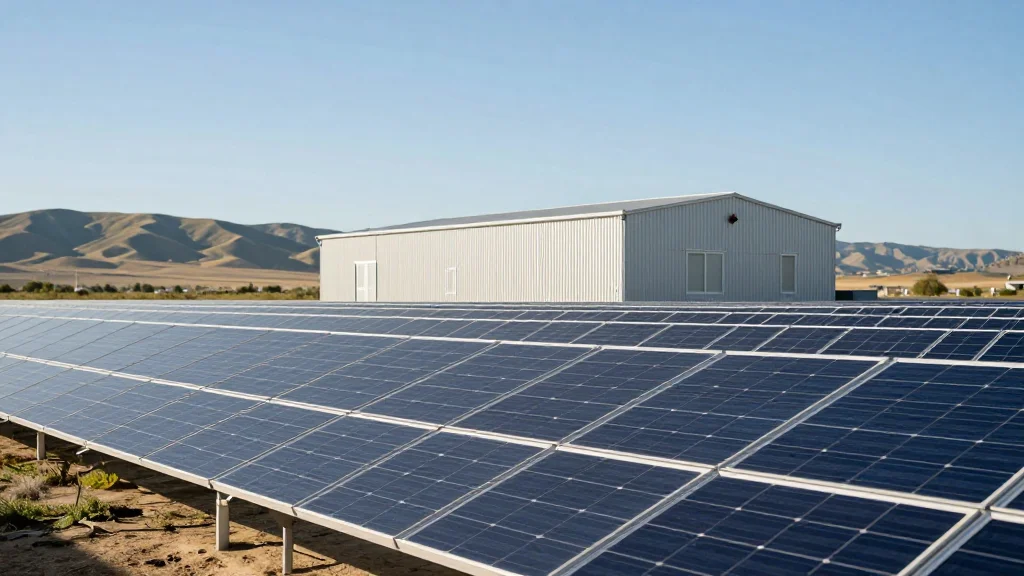
Darden Clean Energy Project Secures $4.95Bn to Build California’s Largest Solar and Battery Facilit
Companies Mentioned
IPX Power
J.P. Morgan
JAM
GOOG
Societe Generale
MUFG - Mitsubishi UFJ Financial Group
Westpac
WBK
Santander
Intesa Sanpaolo
ISP
National Bank of Canada
NA
Crédit Agricole CIB
NORD/LB
Deutsche Bank
DBK
CIBC Capital Markets
HSBC
HSBA

Royal Bank of Canada
Wells Fargo
WFC
BNP Paribas
0HB5
Truist
TFC

Atlcap
MS^K
Standard Chartered
STAN
Why It Matters
The deal proves that massive solar‑plus‑storage projects can be capitalized under the Inflation Reduction Act, accelerating California’s clean‑energy mandate and setting a financing precedent for future utility‑scale renewables.
Key Takeaways
- •$4.95 bn financing combines debt, tax equity, credit transfers.
- •1.15 GW solar paired with 4.6 GWh storage creates world’s largest BESS.
- •Project repurposes 9,500 acres of former farmland in Central Valley.
- •Sets benchmark for IRA‑driven renewable project capital structures.
- •Includes $20 million community benefit commitments for local infrastructure.
Pulse Analysis
California’s renewable agenda is reaching a tipping point as the state pivots from drought‑stricken agriculture to grid‑scale clean power. The Darden Clean Energy Project exemplifies this shift, turning 9,500 acres of idle farmland into a 1.15‑gigawatt solar farm coupled with a 4.6‑gigawatt‑hour battery system. By situating the facility within the Westlands Competitive Renewable Energy Zone, developers tap a high‑insolation corridor while delivering critical storage capacity that can smooth intermittent generation and support peak‑demand periods.
What makes Darden stand out is not just its size but the financing architecture that underwrites it. The $4.95 billion package blends traditional construction debt with sophisticated tax‑equity and investment‑tax‑credit (ITC) transfer mechanisms, a structure that J.P. Morgan called unprecedented. Leveraging the Inflation Reduction Act’s generous tax credits, the deal showcases how developers can marshal private capital to fund multi‑gigawatt projects without relying solely on public subsidies. This model is likely to become a template for future large‑scale renewables, signaling confidence among banks, tax‑equity investors, and credit markets in the durability of U.S. clean‑energy policy.
Beyond financing, Darden’s massive battery component signals a broader industry trend toward integrated solar‑plus‑storage solutions. As California tightens its 2045 zero‑carbon electricity goal, utilities will need flexible resources that can store excess solar output and dispatch it when the grid needs it most. The project’s $15 million infrastructure pledge and $5 million direct community investment also illustrate a growing expectation that large energy projects deliver tangible local benefits. Together, these elements position Darden as a benchmark for how scale, capital structure, and community engagement can converge to accelerate the nation’s transition to a resilient, carbon‑free power system.
Darden Clean Energy Project Secures $4.95Bn to Build California’s Largest Solar and Battery Facilit
Comments
Want to join the conversation?
Loading comments...