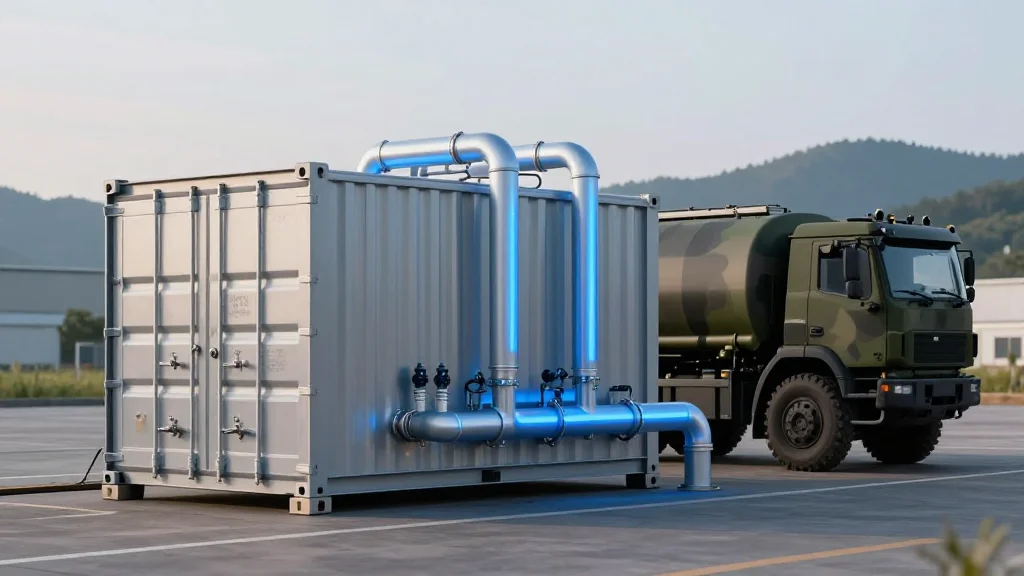
Defense Supplier Pitches Green Hydrogen For Military Electrofuels
Why It Matters
Securing locally produced synthetic fuels reduces dependence on volatile fossil imports and strengthens military readiness, positioning Europe as a leader in defense‑grade green energy.
Key Takeaways
- •Rheinmetall plans "hundreds" of 50 MW micro‑grids across Europe
- •Each plant could produce 5,000–7,000 tonnes of liquid e‑fuel annually
- •Partnerships include INERATEC and ITM Power for modular PtX
- •Synthetic e‑fuels match conventional fuel density for combat operations
- •EU aims fuel sovereignty as fossil prices and geopolitics fluctuate
Pulse Analysis
Europe’s defense sector is turning to green hydrogen as a strategic hedge against fossil‑fuel volatility and supply‑chain fragility. While civilian markets wrestle with competition from battery electric vehicles, military logistics demand a fuel that combines high energy density, storability, and rapid refueling. Synthetic e‑fuels, produced by merging renewable‑generated hydrogen with captured carbon, deliver a drop‑in replacement that can power existing aircraft, vehicles, and generators without redesigning hardware, making them uniquely suited for combat scenarios where electrification is impractical.
Rheinmetall’s Giga PtX blueprint leverages modular, 50‑megawatt electrolyzer units capable of churning out up to 7,000 tonnes of liquid fuel per year. The collaboration with INERATEC provides proven power‑to‑liquid technology, while ITM Power supplies the electrolyzer hardware, creating a turnkey solution that can be deployed rapidly across NATO bases. By distributing production into “hundreds” of micro‑grids, the network reduces transmission losses and mitigates the risk of a single‑point failure, ensuring a resilient, sovereign fuel supply that can be scaled up or down based on operational demand.
If successful, the initiative could reshape Europe’s energy landscape beyond defense, demonstrating a viable pathway for large‑scale, renewable‑based fuel synthesis. It also sends a signal to policymakers that green hydrogen is not merely a climate‑friendly buzzword but a pragmatic tool for national security. In contrast, the United States faces policy uncertainty after recent cuts to its $7 billion clean‑hydrogen program, leaving its own military fuel strategy in flux. Europe’s coordinated push may therefore set a new benchmark for integrating green hydrogen into critical infrastructure worldwide.
Defense Supplier Pitches Green Hydrogen For Military Electrofuels
Comments
Want to join the conversation?
Loading comments...