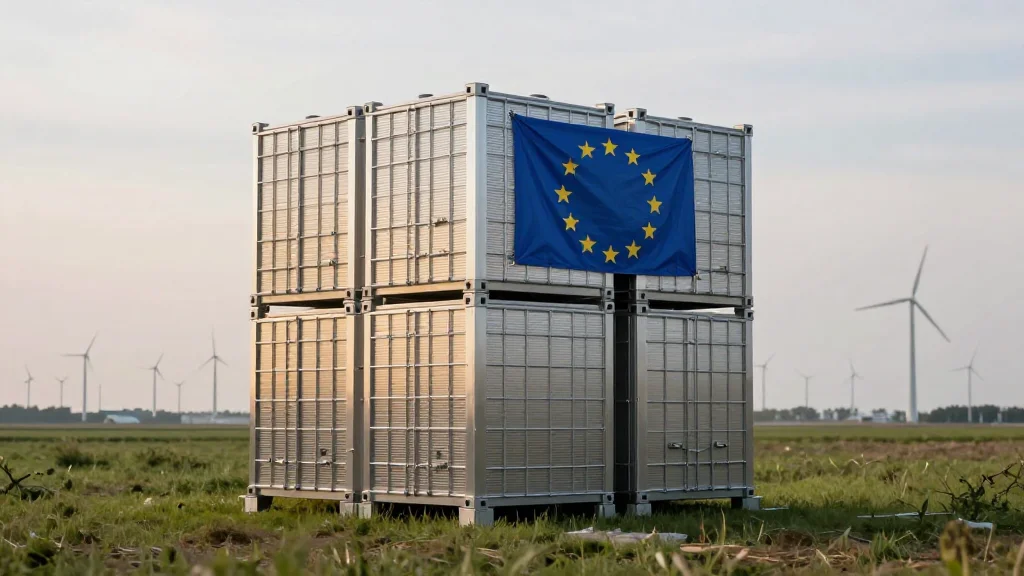
Europe Deploys 3.4 GWh of Battery Storage in March, Capturing 19% of Global Installations

Companies Mentioned
Why It Matters
Europe’s March BESS deployment signals that the continent is moving from pilot‑scale projects to large‑scale, grid‑forming storage solutions. By surpassing its entire 2023 total in a single month, Europe demonstrates that policy frameworks and market mechanisms can rapidly scale storage capacity, a critical component for achieving net‑zero targets. The regional share of 19% of global installations also rebalances the historically China‑centric storage narrative, suggesting a more diversified global supply chain and competitive landscape. The rapid rollout has downstream effects on grid reliability, renewable integration, and electricity market pricing. As storage capacity grows, grid operators can defer costly transmission upgrades, reduce curtailment of wind and solar output, and provide frequency regulation services without relying on fossil‑fuel peakers. For investors, the data underscores a shifting risk‑return profile, where European storage assets may now offer comparable upside to traditional renewable projects, attracting new capital into the sector.
Key Takeaways
- •Europe installed 3.4 GWh of BESS in March, its best month ever and 19% of global deployments.
- •Seven projects of 100 MWh+ came online across Germany, France, England, Scotland and Belgium.
- •The UK’s SSE Renewables added a 300 MWh battery, while Spain commissioned a 9 MWh vanadium flow battery.
- •China remained the largest market with 2,765 MW (8,536 MWh), including a 1 GW/4 GWh project in Inner Mongolia.
- •The March total (18.4 GWh) exceeds the combined global BESS additions of the previous twelve months.
Pulse Analysis
Europe’s March storage surge is more than a statistical outlier; it reflects the convergence of policy, technology cost curves, and market demand. The EU’s recent revisions to the Clean Energy Package, which tighten renewable targets and introduce capacity‑allocation mechanisms for storage, have created a clear revenue stream for battery operators. Coupled with a 12% YoY decline in lithium‑ion battery pack prices, the economics of utility‑scale storage have crossed a profitability threshold that was elusive a few years ago.
Historically, China’s dominance in BESS deployment has been driven by state‑backed financing and a vertically integrated supply chain. Europe’s newfound pace suggests that private‑sector capital, attracted by stable regulatory frameworks and corporate procurement mandates, can rival state‑driven models. This shift could lead to a more competitive global market for battery cells, potentially accelerating cost reductions further. Moreover, the diversification of storage chemistries—evidenced by Spain’s vanadium redox flow battery—indicates that Europe is experimenting with longer‑duration solutions, which are essential for deep‑penetration renewables.
Looking forward, the key question is whether Europe can sustain this momentum through 2026 and beyond. The upcoming commissioning of multi‑gigawatt projects, the rollout of grid‑forming inverter standards, and the integration of storage into ancillary service markets will be decisive. If Europe can lock in a pipeline of projects that collectively exceed 10 GWh by 2027, it will not only solidify its position as a storage leader but also provide a template for other regions seeking to decouple from fossil‑fuel peakers and achieve reliable, low‑carbon electricity supply.
Europe Deploys 3.4 GWh of Battery Storage in March, Capturing 19% of Global Installations
Comments
Want to join the conversation?
Loading comments...