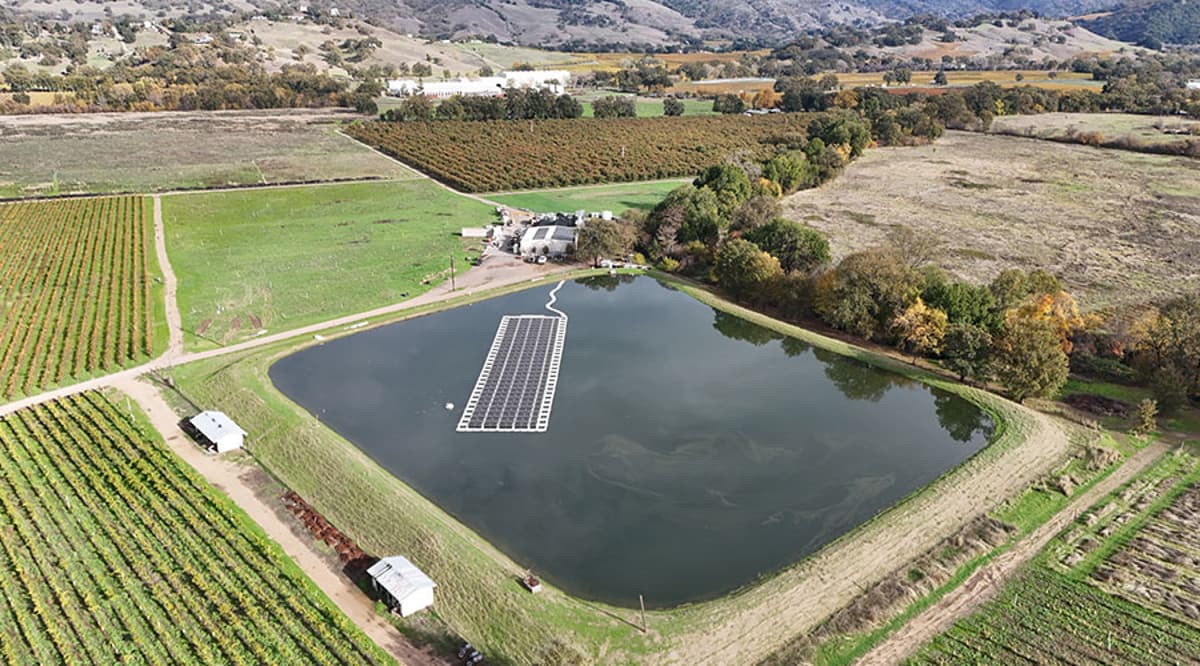
Floating Solar Helps a 74-Year-Old Vineyard Go Fully Renewable
Why It Matters
The project cuts operating costs and carbon emissions while proving that floating solar can deliver clean energy without sacrificing valuable farmland, a model other agribusinesses can replicate.
Key Takeaways
- •Floating solar generates 200,000 kWh annually
- •Saves vineyard roughly $90,000 per year
- •No farmland sacrificed; 1,800 acres remain productive
- •Provides UC Davis research site on FPV ecology
- •Demonstrates PPAs enable zero‑upfront solar adoption
Pulse Analysis
Rising grid electricity prices are prompting farms to seek self‑sufficiency, and floating solar offers a compelling solution where land is at a premium. By installing photovoltaic panels on an existing irrigation pond, Nelson Family Vineyards captures abundant sunlight without encroaching on its 1,800‑acre vineyard. The system’s 200,000 kWh output not only powers the entire operation but also delivers a $90,000 annual cost reduction, illustrating how FPV can turn underutilized water surfaces into high‑value energy assets.
Beyond economics, the Mendocino installation provides a living laboratory for the UC Davis Wild Energy Center. Researchers will monitor how panel shading influences water‑flea populations, aquatic weeds, and overall water quality—factors that directly affect drip‑irrigation efficiency and chemical usage. Findings could reshape best practices for integrating renewable energy with agricultural water management, offering data‑driven pathways to reduce pesticide reliance and protect biodiversity in similar settings.
The project’s financing model, driven by Noria Energy and its parent Sunrock Distributed Generation, leverages Power Purchase Agreements to eliminate upfront capital costs. This structure lowers barriers for midsize farms to adopt advanced solar technologies while delivering predictable energy pricing. As more growers recognize the dual benefits of cost savings and environmental stewardship, FPV is poised to become a scalable component of the broader clean‑energy transition in agriculture, reinforcing the sector’s resilience against volatile energy markets.
Floating Solar Helps a 74-Year-Old Vineyard Go Fully Renewable
Comments
Want to join the conversation?
Loading comments...