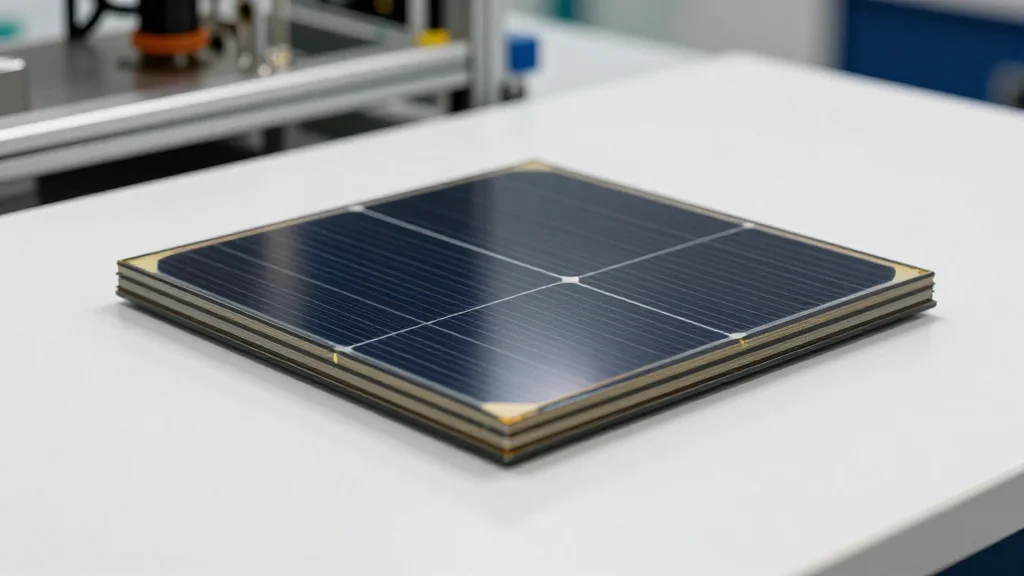
Fraunhofer ISE Opens Perovskite-Silicon Tandem Scale-Up Lab
Why It Matters
The lab shortens the path from lab‑scale breakthroughs to commercial tandem modules, giving European PV makers a competitive edge against low‑cost Chinese panels and helping meet ambitious renewable‑energy targets.
Key Takeaways
- •Fraunhofer ISE opened Pero‑Si‑SCALE lab for 210 mm tandem wafers
- •Lab uses hybrid vacuum‑wet deposition achieving >33% lab‑scale efficiency
- •500 nm perovskite layer raises theoretical efficiency limit to 43.3%
- •Provides EU manufacturers independent R&D infrastructure for tandem solar cells
- •German BMWE funding backs Europe’s target of 30 GW solar capacity by 2030
Pulse Analysis
Perovskite‑silicon tandem cells have emerged as the most promising route to push photovoltaic conversion beyond the silicon ceiling. By stacking a thin, 500‑nanometer perovskite absorber onto a conventional silicon wafer, the theoretical efficiency ceiling jumps from roughly 29% to over 43%, a gain that translates into more power per square meter and reduced material costs. Recent lab records—30.6% on a TOPCon silicon base and 34.8% from industry rivals—demonstrate that the tandem concept is no longer speculative, but on the cusp of commercial viability.
The new Pero‑Si‑SCALE facility in Freiburg operationalizes this promise. Leveraging a hybrid manufacturing flow that combines vacuum coating with wet‑chemical deposition, the lab can process 210 mm × 210 mm wafers at throughput levels compatible with existing silicon lines. This approach preserves the textured silicon surface already used in mass production, allowing manufacturers to adopt tandem technology without overhauling their equipment. Backed by German Federal Ministry funding and equipped with Von Ardenne vacuum systems, the lab offers European PV players a dedicated, independent R&D hub to refine cell architectures, scale module assembly, and validate reliability under real‑world conditions.
Beyond the technical leap, the lab aligns with Europe’s broader solar strategy. Policy analyses from SolarPower Europe stress that targeted interventions are essential to close the cost gap with Chinese producers and hit the EU’s 30 GW annual manufacturing target by 2030. Parallel initiatives such as the EU‑funded Laperitivo project, which pilots large‑area perovskite module production through 2028, reinforce a coordinated push toward a resilient, home‑grown supply chain. Together, these efforts position Europe to capture a larger share of the global PV market while advancing the clean‑energy transition.
Fraunhofer ISE opens perovskite-silicon tandem scale-up lab
Comments
Want to join the conversation?
Loading comments...