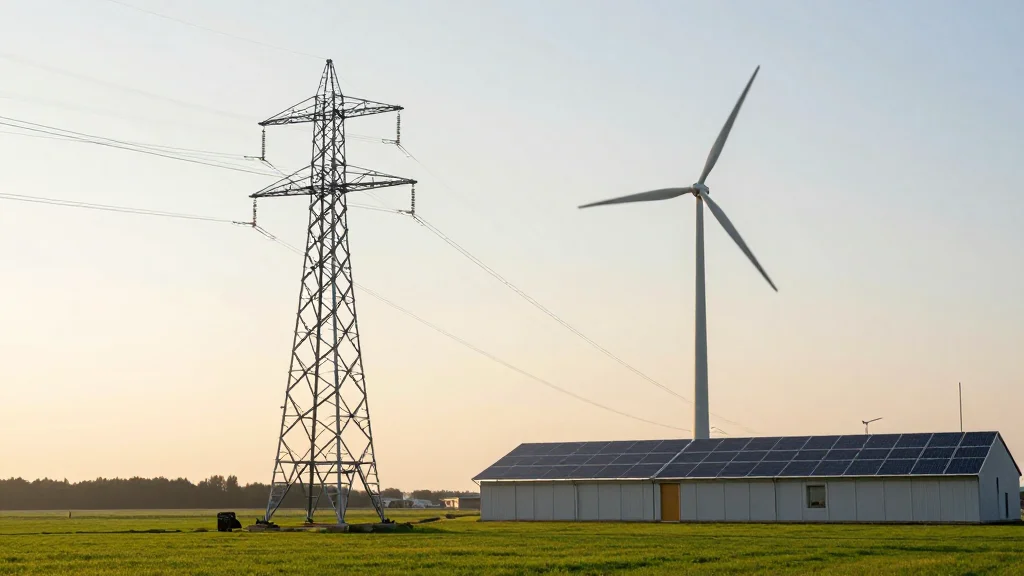
Germany’s Renewable Sector: Reform, Uncertainty and the Race Against the Clock
Why It Matters
The pending reforms will determine whether Germany remains Europe’s flagship renewable market or faces a funding gap that could stall its climate targets. Investor confidence hinges on clear, market‑based rules before 2026.
Key Takeaways
- •Renewables supplied 57.2% of Germany’s electricity in 2025.
- •Solar capacity grew 11.8% YoY; wind up 7.2%.
- •Draft EEG reforms propose CfDs for projects >100 kW.
- •Grid Package could affect 32 GW, $5.3 bn of projects.
- •Unclear grid‑fee regime may delay investments until 2029.
Pulse Analysis
Germany’s renewable surge is reshaping Europe’s energy map. By 2025, more than half of the country’s power came from wind and solar, a milestone that aligns with the EU’s 2030 decarbonisation targets and positions Germany as the continent’s largest clean‑energy market. The rapid expansion, however, has exposed bottlenecks in grid capacity and policy certainty, prompting Berlin to bundle two major reforms—an EEG overhaul and a comprehensive Grid Package—into a tight 2026 timeline.
The EEG draft pushes large installations toward two‑sided contracts for difference, offering downside protection while reclaiming upside gains, and steers new solar projects toward utility‑scale, storage‑co‑located sites. Simultaneously, the Grid Package flags “capacity‑limited” zones where more than 3% of feed‑in was curtailed, potentially stripping priority access from up to 32 GW of pending projects—an exposure of roughly $5.3 bn. Proposed grid‑fee reforms add a capacity‑based charge of $4.3‑$7.6 per kW and a dynamic component tied to congestion, raising concerns that retroactive fees could erode the economics of existing assets.
For developers and financiers, the message is clear: policy clarity will be the decisive factor in 2026. A coordinated, market‑oriented framework could cement Germany’s role as a renewable benchmark and unlock billions of dollars in new investment. Conversely, prolonged uncertainty may divert capital to more predictable jurisdictions, slowing Europe’s overall clean‑energy transition. Stakeholders are therefore watching Berlin’s legislative calendar closely, knowing that execution—not ambition—will shape the continent’s energy future.
Germany’s renewable sector: Reform, uncertainty and the race against the clock
Comments
Want to join the conversation?
Loading comments...