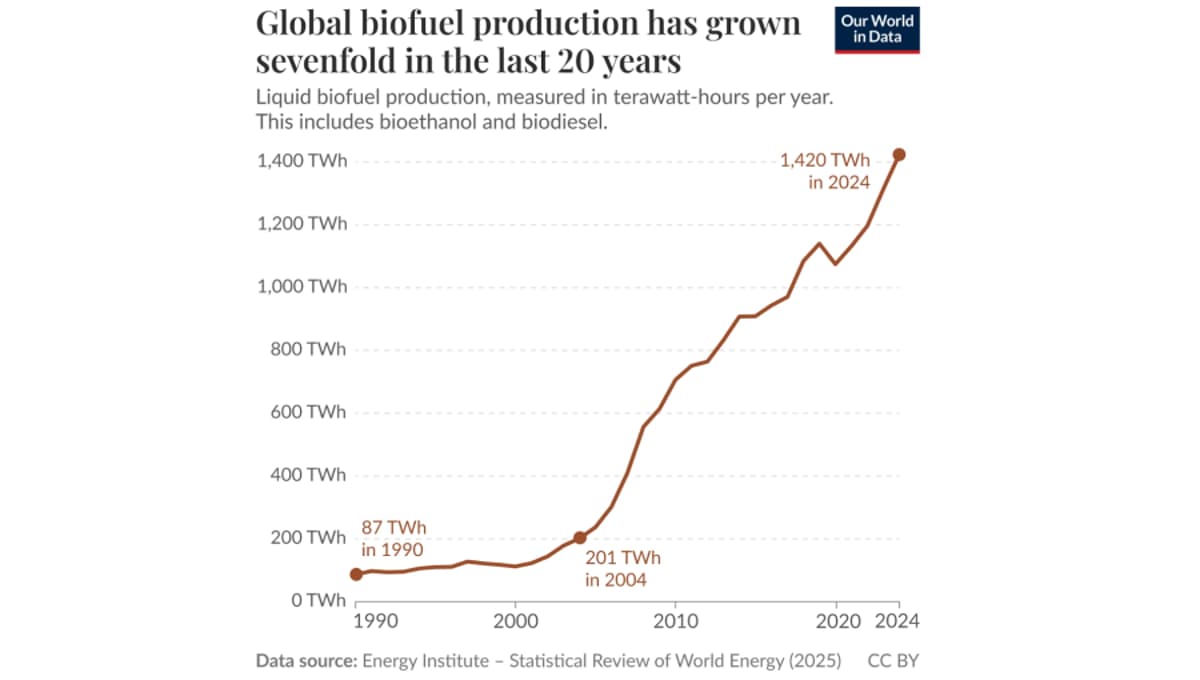
Global Biofuel Production up Sevenfold in the Last Two Decades - OWID
Why It Matters
The rapid scale‑up underscores biofuels’ entrenched role in energy security and highlights a shifting market where they complement, rather than replace, electric mobility in hard‑to‑electrify sectors.
Key Takeaways
- •Global biofuel output rose from ~30 to 210 billion liters.
- •Brazil and the US account for over 60% of production.
- •Policy mandates, like renewable fuel standards, drive recent growth.
- •EV price drops shift biofuel focus to aviation, heavy‑duty.
- •Production expected to rise through 2035 under current regulations.
Pulse Analysis
The sevenfold rise in biofuel output reflects a confluence of agricultural capacity, policy incentives, and early‑stage climate ambition. Brazil leveraged its abundant sugarcane to create a low‑cost ethanol industry, while the United States introduced the Renewable Fuel Standard, compelling refiners to blend corn‑based ethanol into gasoline. These mandates generated a reliable demand pipeline, encouraging investment in feedstock logistics, processing facilities, and research into higher‑yield varieties. As a result, global production swelled to an estimated 210 billion liters, cementing biofuels as a staple of the transport fuel mix.
Meanwhile, the rapid decline in electric‑vehicle prices has reshaped the competitive landscape. While passenger cars now often favor battery power, sectors such as aviation, long‑haul trucking, and maritime shipping remain dependent on liquid fuels due to energy density constraints. Biofuels, especially advanced drop‑in variants, are increasingly positioned as a bridge solution, offering immediate emissions reductions without overhauling existing engine fleets. Blending mandates continue to secure a baseline market, and airlines are experimenting with sustainable aviation fuel derived from waste oils and agricultural residues, signaling a diversification of biofuel applications beyond road transport.
Looking ahead, policy continuity will be pivotal. Nations that maintain or tighten renewable‑fuel quotas are likely to sustain the growth trajectory through 2035, even as sustainability concerns—land use, food‑vs‑fuel debates, and lifecycle emissions—prompt stricter certification standards. Investment is shifting toward second‑generation biofuels, such as cellulosic ethanol and algae‑based fuels, which promise higher yields with lower environmental impact. If these technologies achieve commercial scale, the sector could capture a larger share of the decarbonization portfolio, reinforcing biofuels’ role in a mixed‑energy future.
Global biofuel production up sevenfold in the last two decades - OWID
Comments
Want to join the conversation?
Loading comments...