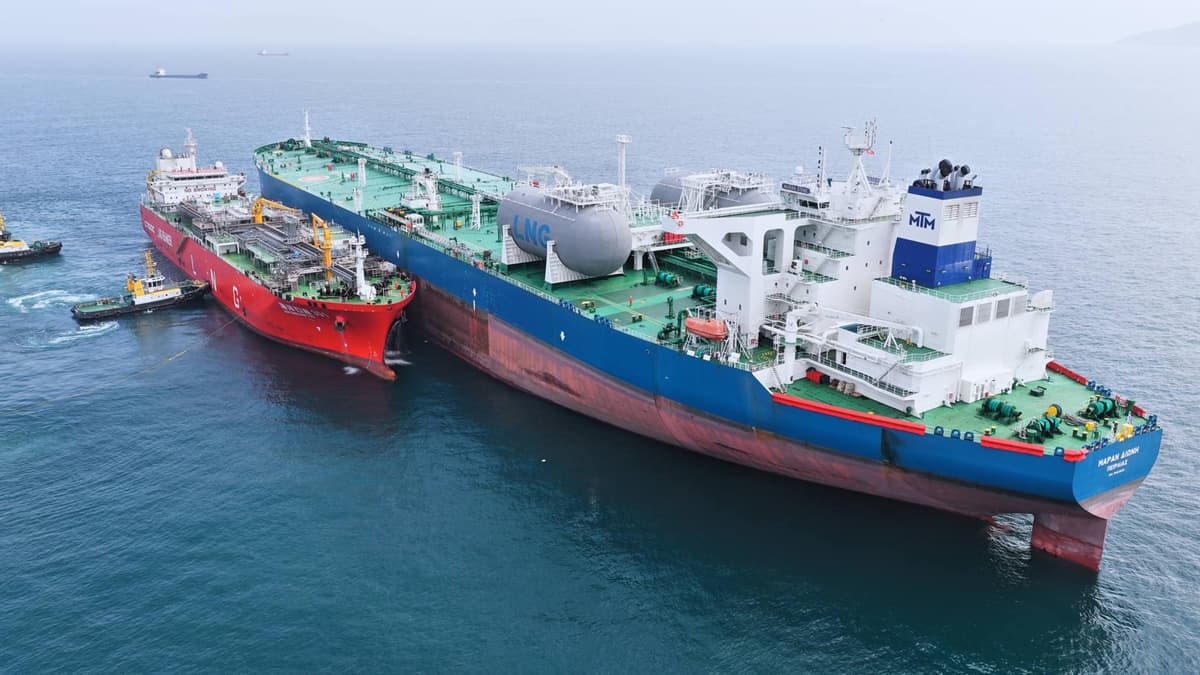
Hong Kong Sees First LNG Ship-to-Ship Bunkering for Very Large Crude Carrier
•March 4, 2026
0
Companies Mentioned
Why It Matters
It proves large‑scale LNG bunkering is viable for ultra‑large vessels, speeding the maritime shift to low‑carbon fuels and cementing Hong Kong’s strategic energy‑hub status.
Key Takeaways
- •First LNG ship‑to‑ship bunkering for a VLCC in Hong Kong.
- •4,700 cubic metres transferred in seven hours.
- •Enables 12,000 nautical miles range without refuel.
- •Haiyang Shiyou 301 is world’s largest LNG bunkering vessel.
- •CLPe and CNOOC showcase Hong Kong as green fuel hub.
Pulse Analysis
The shipping industry is rapidly turning to liquefied natural gas as a bridge fuel, driven by stricter emissions regulations and the International Maritime Organization’s carbon targets. While LNG bunkering has become routine for container ships and smaller tankers, scaling the process to ultra‑large crude carriers has remained a technical hurdle. Hong Kong’s recent demonstration shows that the region’s infrastructure, combined with advanced bunkering vessels, can meet the volume and safety demands of the world’s biggest oil movers.
The seven‑hour transfer to the 330‑metre VLCC Maran Dione involved moving roughly 4,700 cubic metres of LNG from the 200‑metre Haiyang Shiyou 301, the largest dedicated LNG bunkering ship in operation. This cargo equips the dual‑fuel carrier to sail approximately 12,000 nautical miles—enough for a round‑trip between the Middle East and East Asia—without needing another refuel stop. Such range extension not only reduces operational costs but also minimizes emissions by limiting auxiliary fuel consumption during voyages.
Beyond the technical success, the partnership between CLPe and CNOOC signals Hong Kong’s ambition to become a premier green‑fuel hub in the Asia‑Pacific. By proving that ship‑to‑ship LNG can be delivered safely to vessels of VLCC scale, the city positions itself to attract a broader mix of low‑carbon ships, from container lines to bulk carriers. The move is likely to spur further investment in LNG storage, regasification facilities, and regulatory frameworks, accelerating the region’s transition toward a more sustainable maritime ecosystem.
Hong Kong sees first LNG ship-to-ship bunkering for very large crude carrier
0
Comments
Want to join the conversation?
Loading comments...