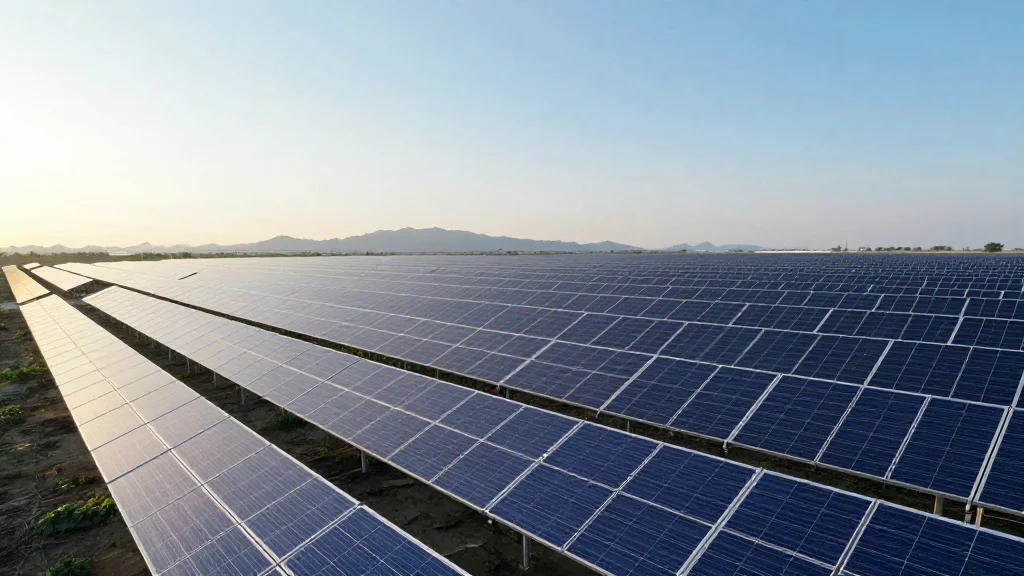
How Big Can Solar Go? These 3 Projects Show Us the Gigascale Future
Companies Mentioned
Why It Matters
These projects prove that solar can be deployed at utility‑scale levels previously reserved for fossil fuels, accelerating decarbonization and redefining grid planning. Their success will set new benchmarks for land use, transmission infrastructure, and energy storage worldwide.
Key Takeaways
- •Adani's Khavda park targets 30 GW solar‑wind capacity by 2025
- •Khavda includes 1.1 GW/3.5 GWh battery, one of world’s largest
- •China’s Talatan Solar Park already produces ~17 GW across seven Manhattans
- •U.S. Westlands plan envisions 21 GW solar on California’s Central Valley
- •Gigascale projects demand new land, transmission, and workforce logistics
Pulse Analysis
The rapid decline in photovoltaic costs and advances in high‑voltage transmission have unlocked a new era of gigascale solar development. In India, Adani Green Energy’s vertically integrated model—spanning panel manufacturing, installation, and grid delivery—allows the Khavda Renewable Energy Park to combine 30 GW of solar‑wind capacity with a massive 1.1 GW battery. China’s Talatan Solar Park leverages the high‑altitude, high‑insolation conditions of the Qinghai plateau, delivering roughly 17 GW across a footprint comparable to seven Manhattan islands. Meanwhile, the Westlands Water District’s Valley Clean Infrastructure Plan illustrates how coordinated regional planning can overcome the United States’ fragmented permitting landscape to target 21 GW in California’s Central Valley.
Scaling projects to gigawatt levels introduces unprecedented logistical challenges. Securing hundreds of square miles of land often requires negotiating with multiple jurisdictions and addressing ecological concerns, as seen in Gujarat’s salt‑flat terrain where Adani built its own desalination plant for a 15,000‑worker camp. Transmission corridors must be engineered to handle multi‑gigawatt outputs, prompting private investment in high‑capacity lines that can move power across vast distances. Moreover, integrating storage—exemplified by Khavda’s 3.5 GWh battery—mitigates curtailment and enables revenue from evening peak rates, but also adds complexity to grid management and financing.
The emergence of gigascale solar reshapes energy markets and policy priorities. By delivering power comparable to traditional baseload plants, these projects can displace coal and natural‑gas generation, accelerating carbon‑neutral targets such as California’s 2045 goal. Their sheer size also drives economies of scale, pushing down levelized cost of electricity and making renewable procurement more attractive for utilities and corporations. As more regions adopt coordinated land‑use strategies and invest in transmission and storage, gigawatt‑plus solar could become a cornerstone of the global energy transition, redefining how and where electricity is generated and consumed.
How big can solar go? These 3 projects show us the gigascale future
Comments
Want to join the conversation?
Loading comments...