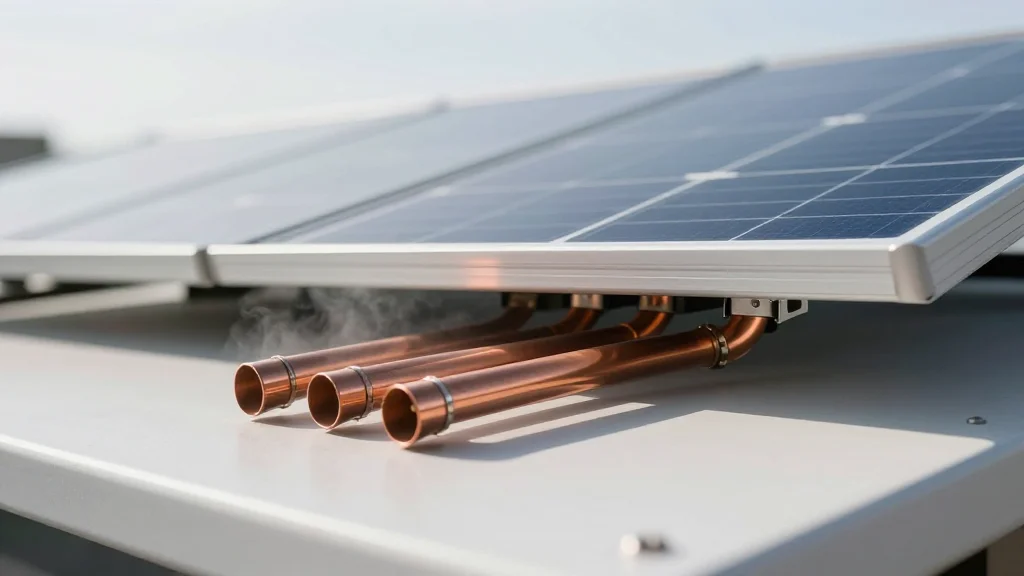
How to Retrofit Commercial PV Panels Into Photovoltaic-Thermal Modules
Why It Matters
The findings show that retrofitting existing PV modules into PVT systems can substantially boost overall energy capture, but only if thermal design challenges are solved, influencing the economics of building‑integrated solar solutions.
Key Takeaways
- •Retrofit PVT achieves ~46‑50% total efficiency, surpassing PV alone
- •Thermal resistance reduces electrical output, especially at low flow rates
- •Heat extraction limited by thermosyphon capacity and interface quality
- •Increasing flow rate improves cooling but cannot fully offset thermal limits
- •Scaling to 6‑7 thermosyphons needed for parity with standard PV
Pulse Analysis
The concept of converting conventional photovoltaic panels into photovoltaic‑thermal (PVT) collectors has attracted attention as a pathway to harvest both electricity and low‑grade heat from the same roof space. While custom‑designed PVT collectors have demonstrated high performance, the Brazilian team focused on a retrofit approach using off‑the‑shelf PV modules, a strategy that could lower upfront costs and accelerate market adoption. By integrating copper thermosyphons—passive, gravity‑driven heat pipes—behind a 60 W polycrystalline panel, the researchers created a hybrid that operates without additional power for fluid circulation, aligning with sustainability goals.
Field tests revealed that the hybrid panel delivered a combined energy efficiency of roughly 46% under clear skies, climbing above 50% when cloud cover reduced solar irradiance but the stored heat continued to be released. The thermal side contributed the bulk of the gain, while the electrical output dipped modestly due to increased rear‑side temperature and reduced natural convection. Flow rate proved critical: at 6.5 L/min the system maintained better electrical performance, whereas a reduced 1.5 L/min flow caused overheating, collapsing electrical efficiency to 10.9% and total efficiency to 19%. These results underscore the delicate balance between heat extraction and electrical loss in retrofit designs.
The study’s practical implications are twofold. First, it quantifies the thermal penalty and sets a clear target—about a 60% boost in heat‑extraction capacity, achievable by adding more thermosyphons or improving thermal contact—to match the performance of a standard PV panel. Second, it highlights design levers such as thermosyphon geometry, working fluid selection, and interface engineering that can be optimized for commercial scalability. As building‑integrated solar gains momentum, these insights help developers assess the cost‑benefit trade‑offs of PVT retrofits and guide future research toward economically viable, high‑efficiency hybrid systems.
How to retrofit commercial PV panels into photovoltaic-thermal modules
Comments
Want to join the conversation?
Loading comments...