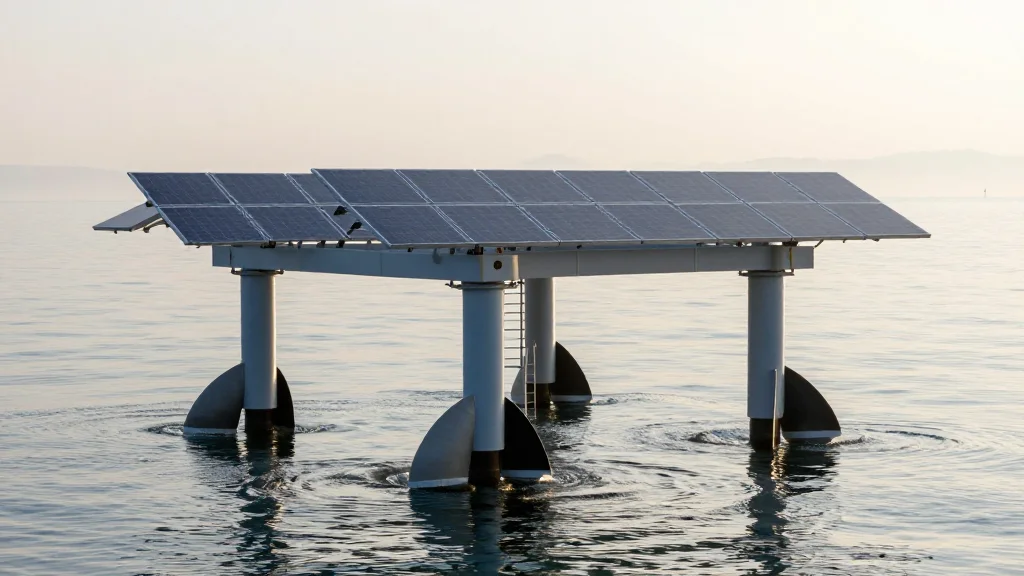
Hybrid Tidal-Photovoltaic System for Modular Renewables Deployment in Estuarine Channels
Why It Matters
The hybrid approach demonstrates a cost‑effective pathway to harness both tidal and solar resources, expanding viable renewable options for densely populated estuarine regions. Its low LCOE and modular design could accelerate deployment of clean energy infrastructure in coastal economies.
Key Takeaways
- •Hybrid tidal-PV farms achieve up to 24 GWh/year in estuaries
- •Optimal turbine spacing (60D) cuts LCOE to $0.30/kWh
- •PV panels offset wake losses, boosting overall energy yield
- •Modular floating units enable scalable deployment across 0.5 km × 3 km area
Pulse Analysis
The convergence of tidal and solar power has long been viewed as a way to smooth the intermittency of each resource, yet practical designs have lagged behind. The Brazilian team’s floating hybrid farm bridges that gap by mounting high‑efficiency (23 %) photovoltaic panels on a catamaran‑type platform that also supports a diffuser‑augmented hydrokinetic turbine. In the simulated Boqueirão Channel—characterized by semidiurnal tides exceeding 6 m and daily solar irradiation of 5–5.5 kWh/m²—the combined system captures kinetic energy during flood and ebb cycles while generating electricity from sunlight when currents slacken. This dual‑capture strategy maximizes the energy density of limited estuarine real estate.
Wake effects, a notorious efficiency drag in turbine arrays, were quantified through numerical modeling. The study found that lateral spacing of three turbine diameters eliminates cross‑stream interference, while longitudinal gaps of 60 diameters restore the downstream power coefficient to 0.80, up from 0.64 at 40 diameters. Adding a 2.48 kW PV module to each unit compensates for the residual loss, lifting total annual output to nearly 24 GWh in the most aggressive layout. Crucially, the levelized cost of energy drops to $0.30/kWh—competitive with on‑shore wind and well below many offshore solar projects.
From a market perspective, the modular nature of the 4.5 m × 2 m hybrid units enables phased investment and rapid scaling across channels, rivers, and coastal lagoons worldwide. Developers can leverage the presented decision‑support framework to evaluate site‑specific trade‑offs between turbine density, PV coverage, and capital outlay, shortening the pre‑feasibility timeline. As governments tighten carbon targets and seek resilient, land‑scarce power sources, such hybrid arrays offer a compelling portfolio addition, potentially unlocking new financing streams and stimulating supply‑chain growth for diffuser‑augmented turbines and marine‑rated solar panels.
Hybrid tidal-photovoltaic system for modular renewables deployment in estuarine channels
Comments
Want to join the conversation?
Loading comments...