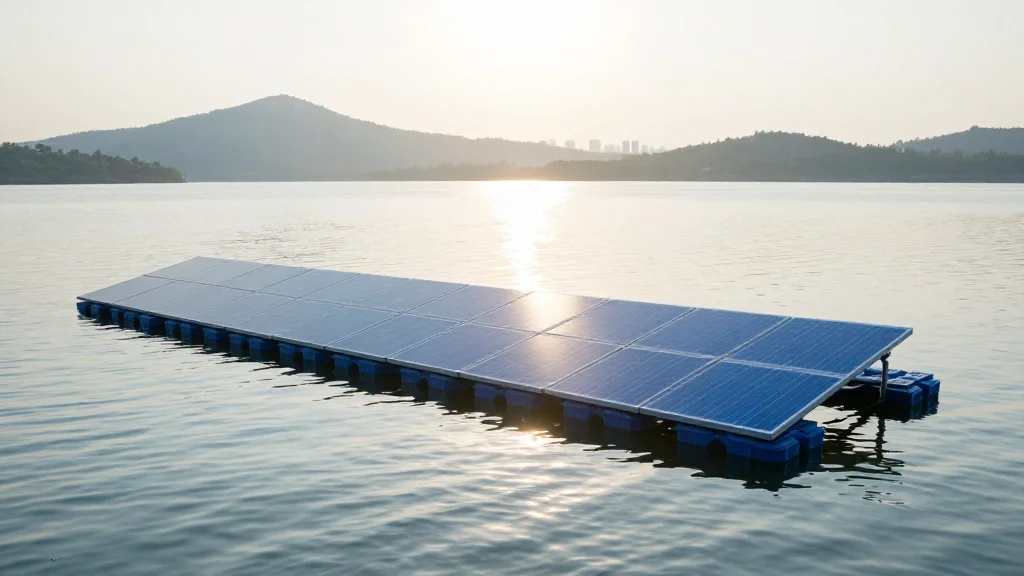
India’s Floating PV Potential Estimated at 102 GW
Why It Matters
Floating solar unlocks vast, under‑utilized water resources, easing land pressure and boosting India’s renewable‑energy targets. The new potential reshapes investment pipelines and policy focus across the country’s power sector.
Key Takeaways
- •India’s floating solar potential totals roughly 102 GW.
- •Only 20 % of eligible water bodies can host panels.
- •Maharashtra leads with 16.3 GW of deployable capacity.
- •NISE assumes 545 W, 21 % efficient modules at 5° tilt.
- •Effective area required: 0.019 km² per MW of capacity.
Pulse Analysis
India’s floating solar assessment arrives at a pivotal moment as the nation strives to meet its 450 GW renewable‑energy goal by 2030. By tapping 1,946 km² of water surfaces—equivalent to roughly 102 GW of capacity—developers can circumvent the acute land‑availability constraints that have slowed ground‑mounted projects. The NISE methodology, which filters sites by depth, irradiation, and proximity to grid infrastructure, offers a realistic roadmap for large‑scale deployment, positioning India among the world’s leaders in floating photovoltaics.
Policy momentum is building, with the Ministry of New and Renewable Energy preparing a dedicated financing and incentive scheme for floating solar. State governments, especially Maharashtra, Madhya Pradesh and Karnataka, are poised to attract private capital as the report highlights clear, quantifiable assets. The 20 % utilization cap balances energy generation with ecological concerns, preserving fisheries and biodiversity while still delivering substantial megawattage. Investors can anticipate streamlined permitting processes and potential subsidies that mirror successful offshore wind models, making floating solar an increasingly attractive asset class.
Technically, the NISE scenario assumes 545‑watt, 21 % efficient modules installed at a modest 5‑degree tilt, requiring only 0.019 km² of water per megawatt. This low profile reduces visual impact and simplifies anchoring systems, while the shallow‑water depth range (3‑30 m) aligns with existing reservoir and dam infrastructure. As climate resilience becomes a priority, floating solar also offers ancillary benefits such as reduced evaporation and improved water quality, reinforcing its strategic value for India’s energy transition.
India’s floating PV potential estimated at 102 GW
Comments
Want to join the conversation?
Loading comments...