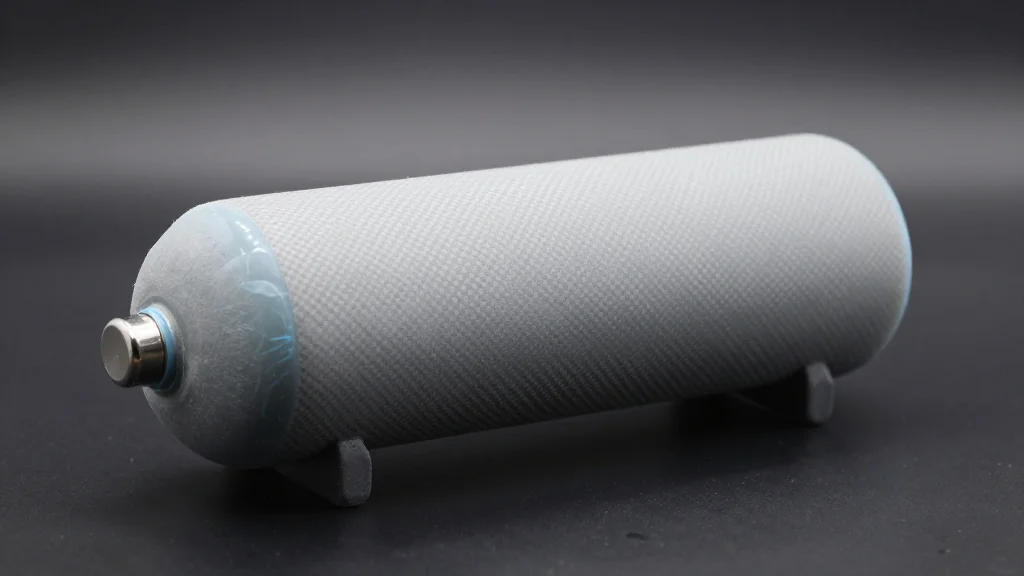
Innovation Awards: CTC Also Recognised for Its LeiWaCo Lightweight Tank for Liquid Hydrogen in the Pipes, Tanks and Hydrogen Category
Companies Mentioned
Why It Matters
By cutting the weight and cost of LH₂ storage, LeiWaCo makes hydrogen‑powered transport more economically viable and accelerates the rollout of low‑carbon vehicles and vessels. Its cross‑sector design opens a pathway for large‑scale hydrogen logistics, a critical bottleneck in the clean‑energy transition.
Key Takeaways
- •LeiWaCo eliminates cryogenic microcracking in composite liquid‑hydrogen tanks.
- •Thermoplastic matrix and thin layup cut internal stress, boost durability.
- •Tanks are ~30% lighter than traditional metal LH2 containers.
- •Enables lighter, cheaper hydrogen transport for trucks, aircraft, ships.
- •Demonstrator validated at –253 °C, paving path to commercial rollout.
Pulse Analysis
Hydrogen’s promise as a zero‑emission fuel hinges on efficient, safe storage. Liquid hydrogen (LH₂) offers high energy density, but the extreme –253 °C required for liquefaction induces differential contraction between carbon fibres and conventional epoxy matrices, creating microcracks that leak the smallest atom of all. Metal tanks avoid this issue but add significant weight, eroding the efficiency gains of hydrogen‑powered vehicles. Overcoming cryogenic microcracking has therefore been a decisive hurdle for composite LH₂ containers.
LeiWaCo’s breakthrough lies in a holistic redesign of the tank architecture. By switching to a high‑strain‑capacity thermoplastic matrix, the material tolerates greater thermal contraction without fracturing. Engineers reduced laminate thickness, refined fibre orientation, and introduced an all‑composite liner that removes the coefficient‑of‑thermal‑expansion mismatch between core and skin. Integrated micro‑ and macro‑scale simulations guided these choices, while automated lay‑up processes were adapted to handle the thinner plies, keeping production costs in check. The result is a demonstrator that survived repeated cryogenic cycles, proving the concept’s durability and scalability.
The commercial implications span multiple sectors. In aerospace, a 30% weight reduction translates into longer range or higher payload for hydrogen‑fueled aircraft, helping the industry meet ambitious decarbonisation targets. Maritime operators gain corrosion‑resistant, lightweight tanks that preserve vessel stability, while logistics firms can ship larger hydrogen volumes at lower cost, accelerating the rollout of hydrogen‑powered trucks and buses. Backed by German federal funding and Swiss Innosuisse, and involving partners from DLR to Teijin Carbon, LeiWaCo positions CTC and its Airbus parent at the forefront of the emerging hydrogen supply chain, a market projected to exceed $200 billion by 2035.
Innovation Awards: CTC also recognised for its LeiWaCo lightweight tank for liquid hydrogen in the Pipes, Tanks and Hydrogen category
Comments
Want to join the conversation?
Loading comments...