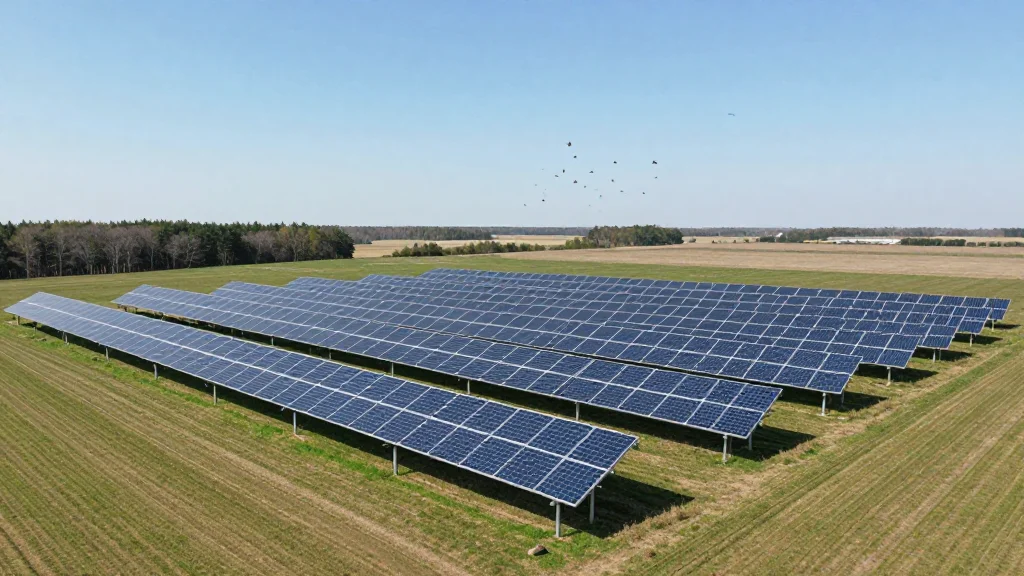
Intelligent Solar Siting Neutralizes Local Opposition at Near-Zero Cost
Why It Matters
The findings prove that environmentally responsible solar siting need not sacrifice economics, enabling faster approvals and lower soft‑cost risks for the clean‑energy transition. This shifts industry assumptions and gives policymakers a data‑driven path to balance energy, agriculture, and conservation goals.
Key Takeaways
- •Biodiversity-first siting adds only 0.17% to system costs
- •Least-cost solar clusters on pastures, threatening grassland bird habitats
- •Agricultural preservation shifts solar onto timberland, risking deforestation
- •Macro‑siting reduces permitting delays and NIMBY opposition
- •Framework adaptable to other states for balanced land‑use planning
Pulse Analysis
The Cornell‑led research introduces a macro‑siting algorithm that layers transmission proximity, slope, soil and road access with ecological and agricultural priorities. By running three distinct scenarios—least‑cost, farm‑preserving, and biodiversity‑focused—the model quantifies how each objective reshapes the spatial footprint of the 46 GW solar buildout envisioned for New York. The biodiversity‑first scenario, often dismissed as financially prohibitive, actually raises annualized costs by just 0.17%, a negligible premium that can be absorbed without harming project returns.
For developers, the practical upside is clear. Early identification of high‑conflict parcels allows firms to submit cleaner interconnection requests, sidestepping costly permitting delays and community lawsuits that can add months and millions of dollars to a project. By integrating the dual‑criterion siting tool into pre‑construction workflows, EPCs and asset managers can de‑risk pipelines, improve stakeholder relations, and preserve internal rates of return while meeting emerging ESG expectations. The study’s cost‑neutral evidence also equips utilities with a defensible narrative when confronting NIMBY opposition, turning environmental stewardship into a competitive advantage.
Policymakers can leverage the framework beyond New York, calibrating it to regional land‑use patterns, climate goals, and biodiversity hotspots. As states race to meet renewable targets, the ability to balance energy output with farmland protection and habitat conservation becomes a strategic asset. The model’s scalability promises a standardized, data‑driven approach to land‑use planning that aligns federal clean‑energy incentives with local conservation mandates, accelerating a just transition across the United States.
Intelligent solar siting neutralizes local opposition at near-zero cost
Comments
Want to join the conversation?
Loading comments...