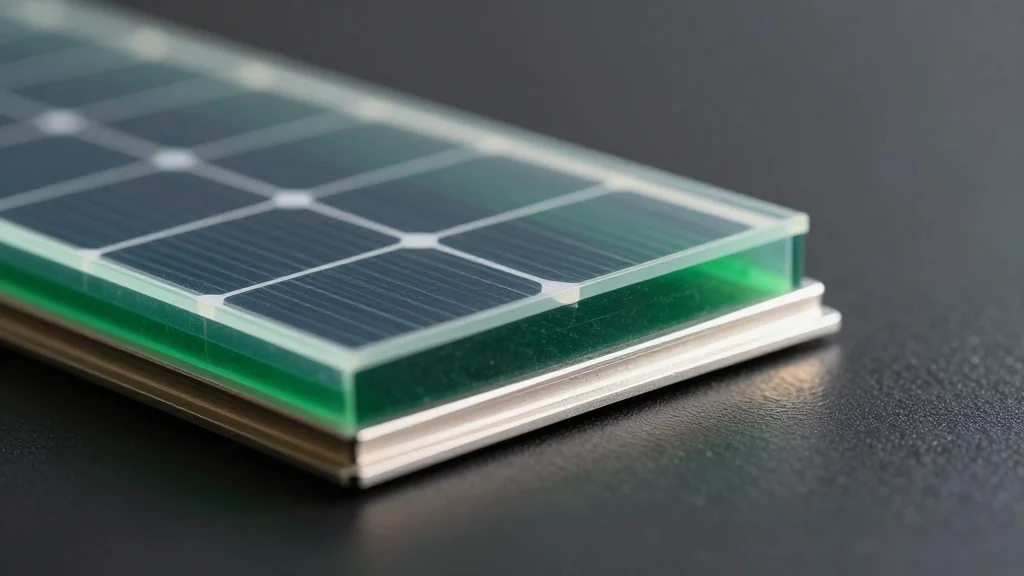
Japanese Scientists Achieve World Record 25.14% Efficiency for Perovskite-CIGS Tandem Solar Cell
Why It Matters
Breaking the 25% efficiency ceiling brings tandem photovoltaics closer to commercial viability, offering higher energy yield and lower system costs for the rapidly expanding renewable market.
Key Takeaways
- •Record 25.14% efficiency for perovskite‑CIGS tandem cell
- •2‑terminal design uses 1 cm² active area
- •New barrier layer improves perovskite crystallinity and reduces recombination
- •Open‑circuit voltage reached 1.845 V, fill factor 83.5%
- •Researchers aim to boost current density for commercial viability
Pulse Analysis
The solar‑energy sector has long chased efficiencies beyond the 25 % threshold, a benchmark that separates laboratory breakthroughs from viable commercial products. Japanese researchers at Tokyo City University, in partnership with the National Institute of Advanced Industrial Science and Technology (AIST), have now set a new world record with a perovskite‑CIGS tandem cell delivering 25.14 % power conversion efficiency under standard test conditions. This achievement eclipses the previous 24.6 % record held by Germany’s Helmholtz‑Zentrum Berlin and demonstrates that the combination of a perovskite top absorber and a CIGS bottom cell can surpass the performance limits of single‑junction silicon modules.
The breakthrough stems from a two‑terminal (2T) architecture that stacks a 1 cm² perovskite absorber atop an AIST‑fabricated CIGS layer, linked by a novel barrier interface. The barrier promotes higher perovskite crystallinity while suppressing interfacial recombination and chemical cross‑talk, resulting in an open‑circuit voltage of 1.845 V, a short‑circuit current density of 16.25 mA cm⁻², and an 83.5 % fill factor. By fine‑tuning the electron‑transport layers—using C₆₀ and atomic‑layer‑deposited SnO₂—the team minimized resistive losses and maximized light harvesting.
From a market perspective, breaking the 25 % barrier positions perovskite‑CIGS tandems as serious contenders for utility‑scale and rooftop installations, where higher efficiency translates directly into lower balance‑of‑system costs. The Japanese team’s roadmap emphasizes boosting short‑circuit current through optical and material optimizations, a step that could push efficiencies toward the 30 % horizon envisioned by next‑generation photovoltaic roadmaps. As global demand for clean energy accelerates, investors and manufacturers will watch how quickly these lab‑scale cells can be scaled, encapsulated, and produced at volume without sacrificing the record‑setting performance.
Japanese scientists achieve world record 25.14% efficiency for perovskite-CIGS tandem solar cell
Comments
Want to join the conversation?
Loading comments...