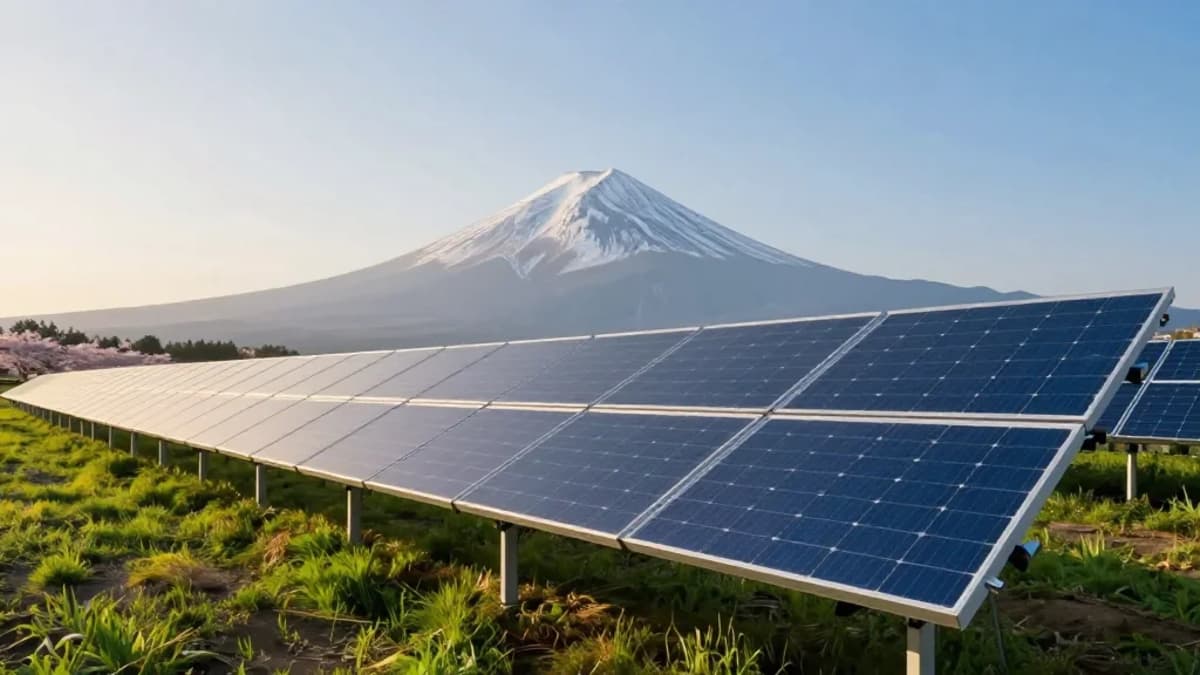
Japan’s 27th Solar Auction Concludes with Average Final Price of $0.029/kWh
•March 9, 2026
0
Why It Matters
The declining auction prices make solar increasingly cost‑competitive, accelerating Japan’s renewable‑energy transition and reducing reliance on fossil fuels.
Key Takeaways
- •79 MW awarded at JPY 4.61/kWh average price.
- •Lowest bid hit JPY 0/kWh for 400 kW project.
- •Highest bids reached JPY 6.49/kWh, still below ceiling.
- •Average price down from 25th auction’s JPY 6.58/kWh.
- •Zero‑price bids signal private PPAs driving auction participation.
Pulse Analysis
Japan’s Green Investment Promotion Organization concluded its 27th utility‑scale solar auction on a modest 79 MW of capacity, posting an average winning price of JPY 4.61/kWh (about $0.029). The auction featured a striking zero‑yen bid for a 400 kW project, reflecting a private power‑purchase agreement that secured grid connection without relying on the subsidy mechanism. The auction capped bids at JPY 8.68/kWh and selected 11 projects ranging from 72 kW to 29.9 MW. Compared with the 25th auction’s average of JPY 6.58/kWh, the price trajectory underscores a steady decline in procurement costs, aligning with the government’s ambition to reach 45 GW of solar capacity by 2030.
Such low‑price outcomes signal that Japanese solar developers are increasingly leveraging corporate PPAs and cost‑efficient engineering to compete on price alone. The highest winning bid of JPY 6.49/kWh remains well under the ceiling of JPY 8.68/kWh, indicating ample headroom for further cost reductions. Internationally, Japan’s average now rivals the most competitive European feed‑in auctions, suggesting that domestic policy stability and a mature supply chain are delivering economies of scale comparable to global benchmarks. This price compression also reduces the levelized cost of electricity, making solar projects more attractive to institutional investors.
Looking ahead, the prevalence of zero‑price bids may prompt regulators to tighten eligibility criteria, ensuring that auction slots reward genuine cost efficiencies rather than pre‑secured off‑taker contracts. If the downward price trend continues, solar could become the cheapest new electricity source in Japan, accelerating the phase‑out of coal and supporting the country’s 2050 net‑zero pledge. Investors will likely monitor upcoming auctions closely, as the evolving price dynamics reshape risk assessments and capital allocation across the broader renewable energy portfolio. Policy makers may also consider integrating storage incentives to further enhance solar’s dispatchability.
Japan’s 27th solar auction concludes with average final price of $0.029/kWh
0
Comments
Want to join the conversation?
Loading comments...