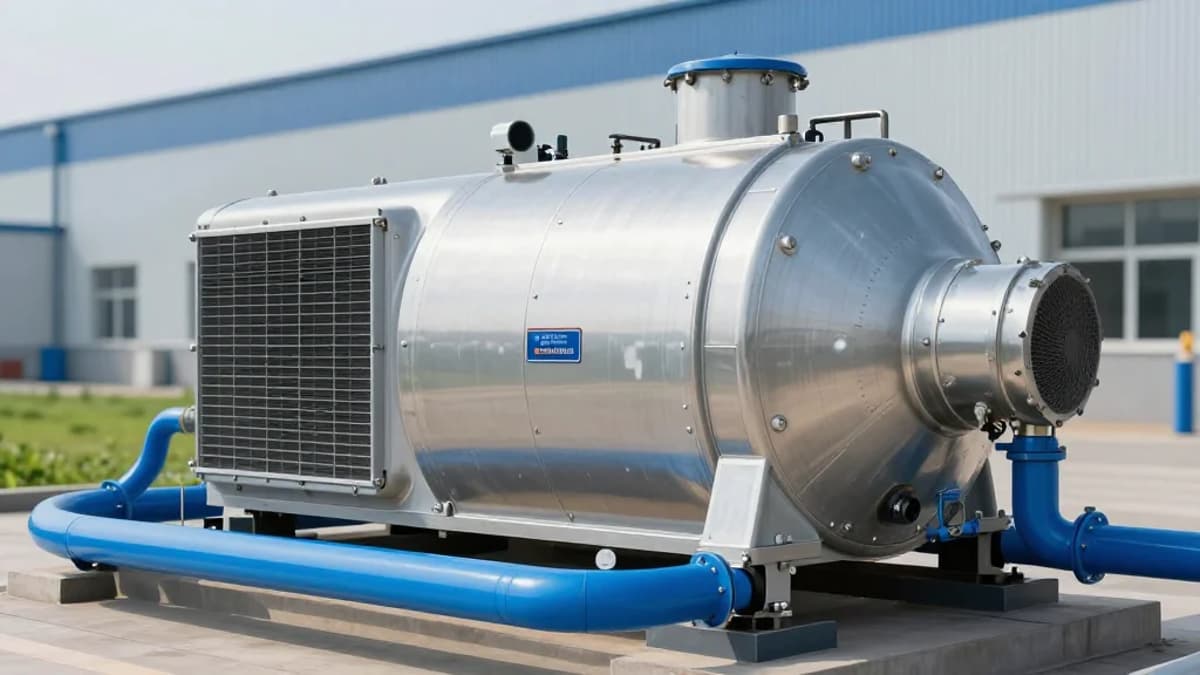
Mega Heat Pumps for Industry and District Heating: New Projects Across Europe Show Potential
•March 10, 2026
0
Why It Matters
The projects demonstrate that large heat pumps can deliver gigawatt‑scale, low‑carbon heat, accelerating industrial decarbonisation and municipal climate goals. Their success lowers economic barriers and signals a shift toward renewable‑based heating in Europe’s energy mix.
Key Takeaways
- •Turboden's 12 MW heat pump cuts 19,000 t CO₂ annually.
- •Helsinki's 20‑33 MW air‑to‑water pump serves 30k homes.
- •Mannheim's 165 MW river pump will be world’s largest.
- •Large heat pumps enable industrial process heat decarbonisation.
- •Projects use natural refrigerants CO₂ and isobutane.
Pulse Analysis
Europe’s heat‑pump market is entering a new era as manufacturers scale up capacity to meet industrial and municipal demand. The technology, once limited to modest residential units, now supports multi‑megawatt installations that tap low‑grade waste heat, ambient air, or river water. By leveraging natural refrigerants such as CO₂ and isobutane, these systems achieve high coefficients of performance while minimizing environmental impact, positioning them as a cornerstone of the continent’s broader energy transition.
The recent projects illustrate diverse use cases. In Austria, Turboden’s 12 MW pump integrates with mechanical vapor recompression to replace fossil‑fuel steam, delivering 150‑180 °C steam for paper production and eliminating 19,000 t of CO₂ annually. Helsinki’s air‑to‑water pump, capable of operating at –20 °C, will provide roughly 200 GWh of heat to 30,000 households, cutting 26,000 t of emissions and complementing electric boilers. Meanwhile, Mannheim’s 165 MW river pump will draw thermal energy from the Rhine, supplying district heating at up to 130 °C and setting a new benchmark for river‑source heat‑pump size.
These deployments signal strong commercial viability and attract public funding, as seen in Germany’s federal programme supporting efficient heating networks. The scalability, combined with renewable electricity, reduces reliance on natural gas and aligns with EU climate targets for 2030. As manufacturers refine high‑speed compressors and system integration, the cost curve is expected to fall, encouraging wider adoption across heavy industry, waste‑heat recovery, and urban heating districts, ultimately reshaping Europe’s low‑carbon heat landscape.
Mega Heat Pumps for Industry and District Heating: New Projects Across Europe Show Potential
0
Comments
Want to join the conversation?
Loading comments...