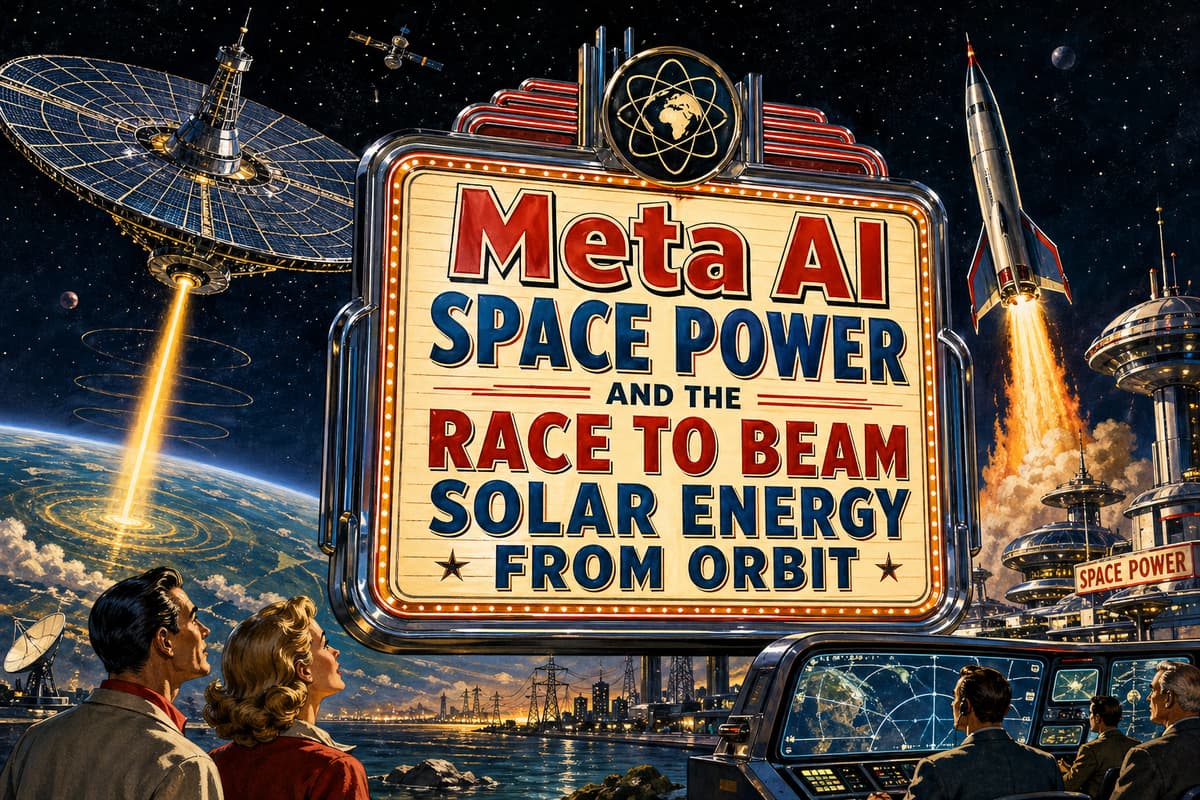
Meta AI Space Power and the Race to Beam Solar Energy From Orbit
Why It Matters
The deal signals that AI‑driven data‑center demand is strong enough to attract early‑stage space‑solar projects, potentially reshaping financing and supply chains in both the renewable‑energy and space‑economy sectors.
Key Takeaways
- •Meta reserves up to 1 GW orbital solar capacity for AI data centers
- •Overview Energy aims for a 2028 orbital demonstration and 2030 commercial launch
- •Near‑infrared beaming lets existing solar farms generate electricity at night
- •Space‑solar could reduce grid interconnection delays for new renewable capacity
- •AI‑driven data‑center demand may accelerate financing for early space‑solar projects
Pulse Analysis
The convergence of artificial‑intelligence workloads and renewable‑energy ambition has created a rare market catalyst for space‑based solar power. Meta’s 1 GW reservation marks the first time a hyperscale cloud player has embedded orbital energy into its procurement mix, joining contracts for wind, solar, nuclear and ultra‑long‑duration storage. By targeting a 2028 proof‑of‑concept, the company is betting that near‑infrared beaming can unlock idle capacity at existing solar farms, effectively turning night‑time into productive generation without new land or interconnection queues. This approach could help AI data centers meet the International Energy Agency’s projection of a near‑doubling of global data‑center electricity use by 2030.
Technically, Overview Energy’s design diverges from legacy microwave concepts by using a wide, low‑intensity infrared beam that existing photovoltaic panels can capture. The challenges are formidable: satellites must sustain high‑efficiency solar arrays, precise beam pointing, thermal management, and radiation‑hard electronics at gigawatt scales. Economic viability hinges on launch cost reductions, mass‑production of space‑grade hardware, and the ability to price the delivered electricity competitively against terrestrial renewables, storage, and nuclear options. Early‑stage financing will likely rely on premium contracts that value reliability and timing over pure cost, positioning space‑solar as a strategic supplement rather than a low‑cost commodity.
For the broader space economy, Meta’s commitment provides a tangible demand signal that could accelerate launch‑provider bookings, in‑space manufacturing investments, and the emergence of insurance products tailored to power‑satellite risk. Regulators will need to harmonize space‑law, aviation safety, and electricity market rules, while public acceptance will depend on transparent safety testing of the infrared beam. If the 2028 demonstration proves safe and effective, it could unlock a new revenue stream for satellite builders and reshape how utilities think about augmenting renewable assets, potentially ushering in a decade where orbital solar becomes a viable component of the clean‑energy mix.
Meta AI Space Power and the Race to Beam Solar Energy From Orbit
Comments
Want to join the conversation?
Loading comments...