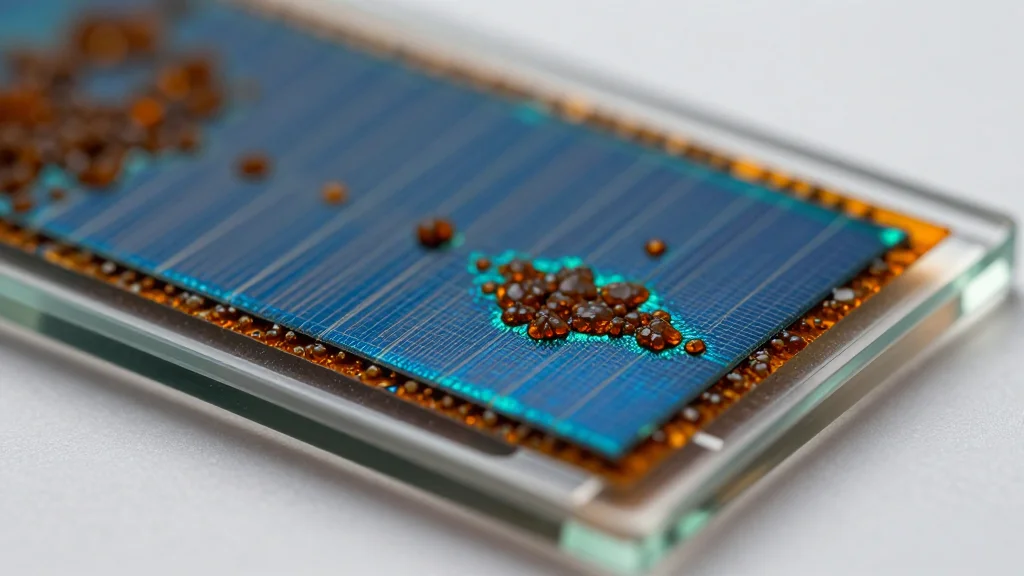
Methoxyl‐Substitution of Phenylethylammonium Strengthened 2D/3D Heterogeneous Structures for Inverted Perovskite Solar Cells with Enhanced Efficiency and Stability
Why It Matters
The breakthrough demonstrates a practical route to combine high efficiency with long‑term stability, addressing two major hurdles for commercial perovskite photovoltaics. By leveraging a simple additive, manufacturers can improve device lifetimes without redesigning existing production lines.
Key Takeaways
- •MeO-PEACl addition improves PCE from 21.1% to 23.1%.
- •Open-circuit voltage rises to 1.16 V, up from 1.11 V.
- •Device retains 98% efficiency after 1850 h at 65 °C.
- •Buried 2D layer remains stable for 3380 h at 65% RH.
- •Methoxy substitution lowers cation solubility, enhancing α‑phase stability.
Pulse Analysis
Perovskite solar cells have surged ahead of traditional silicon thanks to their high absorption coefficients and low‑temperature processing, yet stability under heat and moisture remains a persistent obstacle. Researchers have turned to two‑dimensional (2D) perovskite layers as protective caps for three‑dimensional (3D) absorbers, exploiting the 2D phase’s resistance to environmental stress while preserving the 3D bulk’s superior charge transport. However, integrating these layers without compromising crystallinity or adding costly steps has proven challenging, prompting a search for molecular additives that can self‑assemble into robust heterostructures.
The latest study introduces p‑methoxyphenethylammonium chloride (MeO‑PEACl) as a minimal‑dose additive—just 0.3 % of the precursor solution—to engineer a buried 2D/3D architecture directly during film formation. The methoxy group reduces the cation’s solubility in polar solvents, encouraging it to precipitate at grain boundaries where it forms a thin 2D perovskite sheet that encapsulates the growing 3D grains. This dual action both stabilizes the α‑phase of formamidinium perovskite and passivates interfacial defects, delivering a measurable jump in open‑circuit voltage (1.11 V → 1.16 V) and a 2‑percentage‑point boost in power conversion efficiency (21.1% → 23.1%).
Beyond the lab, the findings have clear commercial relevance. The treated devices retain 98 % of their initial efficiency after more than 1,800 hours of continuous operation at 65 °C and survive over 3,300 hours at 65 % relative humidity without phase degradation—metrics that align with the durability standards required for utility‑scale deployment. Because the additive integrates seamlessly into existing spin‑coating or blade‑coating processes, manufacturers can adopt the technique without major equipment overhauls. The work therefore narrows the gap between perovskite’s record efficiencies and the long‑term reliability demanded by the photovoltaic market, positioning methoxy‑substituted cations as a pragmatic tool for next‑generation solar modules.
Methoxyl‐Substitution of Phenylethylammonium Strengthened 2D/3D Heterogeneous Structures for Inverted Perovskite Solar Cells with Enhanced Efficiency and Stability
Comments
Want to join the conversation?
Loading comments...