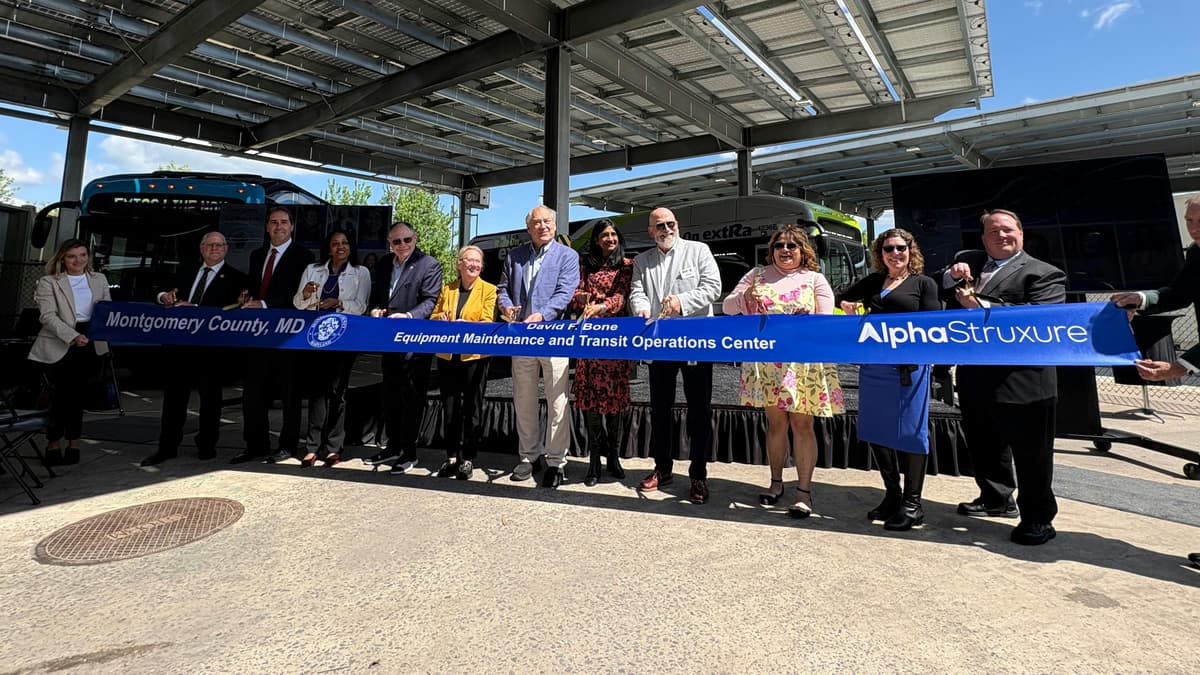
Montgomery County Completes Transit Depot Microgrid Project
Why It Matters
The microgrid provides clean, resilient power for Montgomery’s expanding electric‑bus fleet, reducing emissions and shielding transit service from grid disruptions. It demonstrates a scalable financing and operational model for other jurisdictions pursuing zero‑emission transit.
Key Takeaways
- •6.8‑MW microgrid powers 200 buses and five county buildings
- •AlphaStruxure’s Energy‑as‑a‑Service eliminates upfront capital for the depot
- •Battery storage (2 MW/6.9 MWh) enables island mode during outages
- •Project supports Montgomery’s zero‑emission bus goal for 2035
Pulse Analysis
Montgomery County’s new EMTOC microgrid reflects a growing national trend toward on‑site renewable energy for public transit. By installing 9,800 solar panels across 16 canopies and pairing them with 2 MW of battery storage, the county can generate and store enough electricity to charge 200 electric buses while also supplying power to five ancillary buildings. The system’s 2.38 MW charging capacity and ability to operate in island mode protect the fleet from grid outages, a critical feature for a transit network that logged 19 million rides in 2025.
The financing structure is equally innovative. AlphaStruxure’s Energy‑as‑a‑Service model allows Montgomery to avoid upfront capital expenditures, shifting design, construction, ownership, operation and maintenance to the private partner. This arrangement was bolstered by a $1.6 million grant from the Maryland Energy Administration and a $15 million federal grant for hydrogen‑fuel‑cell buses, illustrating how public‑private collaborations can unlock funding for large‑scale clean‑energy projects. Utilities such as Pepco were integrated early, ensuring seamless grid interconnection and bidirectional energy flows.
For transit agencies nationwide, the EMTOC project offers a blueprint for scaling electric‑bus infrastructure without compromising reliability or fiscal prudence. The microgrid’s modular design can be replicated at other depots, accelerating the transition to zero‑emission fleets while enhancing grid resilience. As Montgomery prepares its Flash Bus Rapid Transit network, the microgrid will serve as a backbone for future expansions, signaling to policymakers that robust, climate‑aligned transit systems are both technically feasible and economically viable.
Montgomery County completes transit depot microgrid project
Comments
Want to join the conversation?
Loading comments...