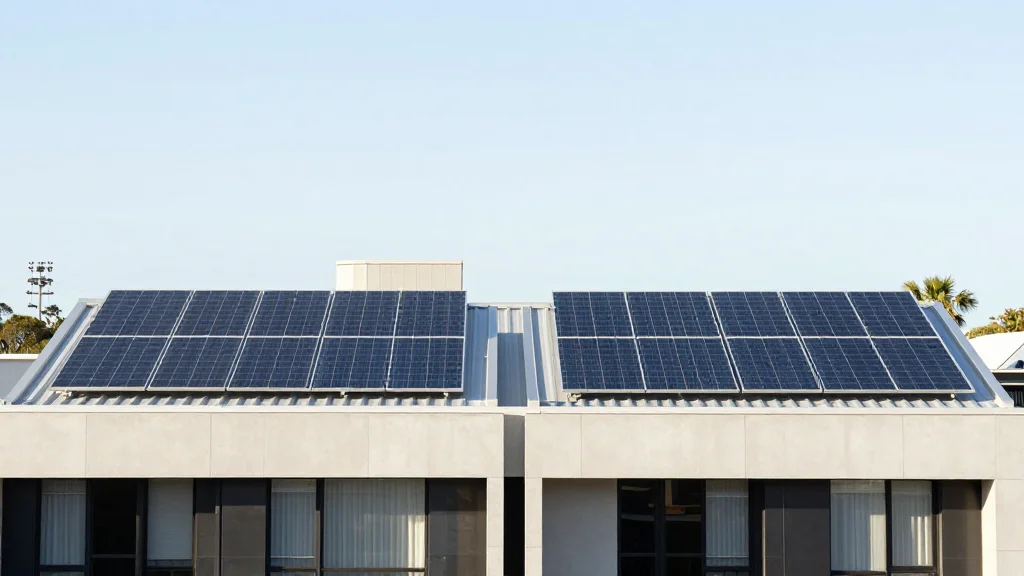
Network Tariffs Blamed for Failure of Warehouses and Businesses to Follow Household Lead on Rooftop Solar
Why It Matters
Addressing tariff complexity and landlord‑tenant misalignment could slash commercial energy costs and accelerate Australia’s 2030 renewable‑energy target, benefiting both businesses and the broader grid.
Key Takeaways
- •Commercial rooftops generate only 5.6 GW versus 22 GW residential
- •Network tariffs represent over 40% of business electricity bills
- •Split‑incentive between landlords and tenants hampers solar adoption
- •Inconsistent tariffs across 16 networks stall multi‑state projects
- •Think tank calls for national "warp‑speed" infrastructure reforms
Pulse Analysis
Australia’s residential rooftop solar boom—over 22 GW installed on four million homes—has starkly contrasted with the commercial sector’s modest 5.6 GW output. This disparity is not due to lack of sunlight but to structural market barriers. Commercial and industrial facilities consume more electricity, especially during daylight hours when solar generation peaks, yet they remain largely panel‑free. Analysts estimate that untapped technical potential across city rooftops could reach 40 GW, or even 80 GW if agricultural sites are included, representing a massive, underutilised resource for grid stability and emissions reduction.
The primary obstacle is the fragmented network tariff regime. Australia’s 16 distribution network service providers levy demand charges that vary by state and even by locality, inflating commercial power bills and making solar projects financially opaque. These tariffs can comprise more than 40% of a business’s electricity cost, eroding the economic case for onsite generation and storage. Coupled with the classic “split‑incentive” dilemma—where landlords own the roof but tenants reap the bill savings—investment decisions stall. Existing policy tools, such as rate‑based loan repayments, have shown promise but remain niche, and broader government incentives continue to target households rather than the commercial middle market.
Experts argue that standardising network tariffs and streamlining connection processes would create a level playing field, encouraging firms to install solar panels and batteries. Such reforms would not only lower operating expenses for businesses but also reduce reliance on large‑scale renewable projects, easing the need for costly transmission upgrades. Accelerating commercial solar deployment aligns with Australia’s goal of 82% renewable electricity by 2030 and supports a smoother transition away from coal. A coordinated, high‑velocity policy response—akin to the nation’s COVID‑19 strategy—could unlock billions in clean‑energy investment and deliver tangible climate and economic benefits.
Network tariffs blamed for failure of warehouses and businesses to follow household lead on rooftop solar
Comments
Want to join the conversation?
Loading comments...