No More Dark Side of the Grid: The Fossil Fuel Empire Loses Ground to Renewables and Storage
Companies Mentioned
Why It Matters
The transition lowers operating costs, cuts emissions, and proves the economic viability of high‑renewable, storage‑rich systems for remote and industrial users, offering a scalable model for fragmented grids worldwide.
Key Takeaways
- •NEM renewables >50% in Q4 2025, coal at record low.
- •Battery discharge tripled, driving wholesale price drop to $50/MWh.
- •Horizon Power runs 34 microgrids, cutting diesel use by thousands of litres.
- •Fortescue targets >1 GW solar, hundreds MW wind, GWh storage for off‑grid mines.
- •Remote Indigenous communities adopt solar‑battery systems, improving reliability and air quality.
Pulse Analysis
Australia’s energy transition is no longer a single‑grid narrative but a mosaic of experiments that together are reshaping the nation’s power landscape. In the final quarter of 2025, renewables and storage accounted for just over 50% of NEM generation, while coal fell to its lowest quarterly output since the market’s inception. Battery discharge surged three‑fold, driving wholesale electricity prices down to roughly $50 per megawatt‑hour, debunking the myth that higher renewable penetration inflates costs. This milestone demonstrates that a large, competitive market can integrate substantial clean energy without sacrificing price stability.
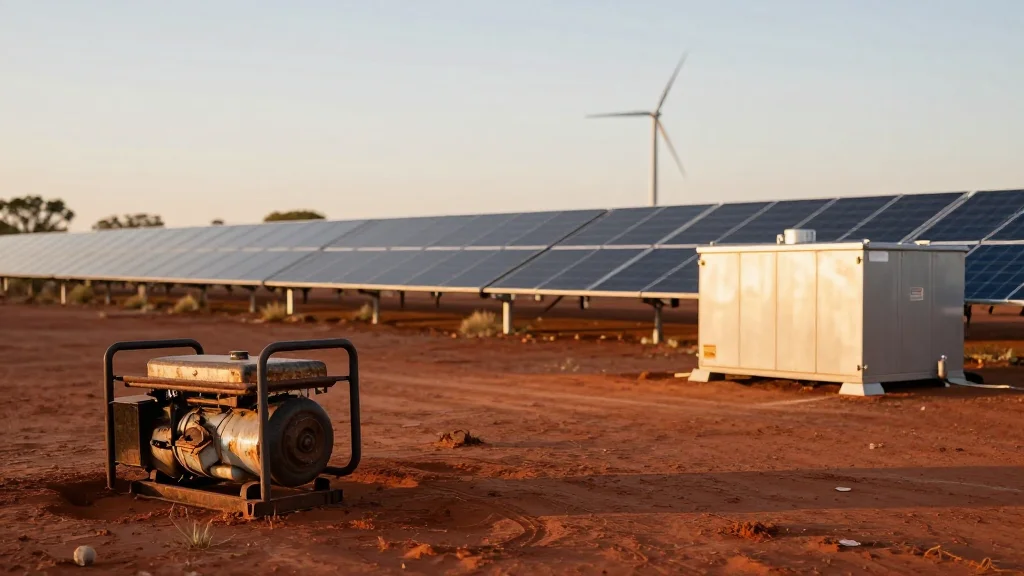
Beyond the NEM, Australia’s remote and regional grids are leading a parallel revolution. Horizon Power’s 34 microgrids across Western Australia now blend solar, wind and advanced storage, slashing diesel consumption by thousands of litres and delivering more reliable power to mining towns and Indigenous communities. The ReGen program’s solar‑battery installations are replacing aging diesel generators, cutting fuel costs and improving air quality in some of the country’s most isolated settlements. These decentralized systems prove that high‑renewable, storage‑rich configurations can thrive even where traditional transmission infrastructure is impractical.
The private sector is amplifying the trend, with mining giant Fortescue fast‑tracking an off‑grid green hub in the Pilbara that aims for over a gigawatt of solar, hundreds of megawatts of wind and several gigawatt‑hours of battery storage. By eliminating diesel and gas, the project promises significant operating‑cost savings and insulation from volatile fuel markets. Collectively, these developments provide a template for other islanded or semi‑islanded grids—from the Pacific to South Asia—showing that existing wind, solar, inverter and market tools are sufficient to decarbonise constrained systems without exotic technology. The Australian experience underscores that the economic and reliability case for renewables and storage is now compelling across both urban and remote settings.
No more dark side of the grid: The fossil fuel empire loses ground to renewables and storage
Comments
Want to join the conversation?
Loading comments...