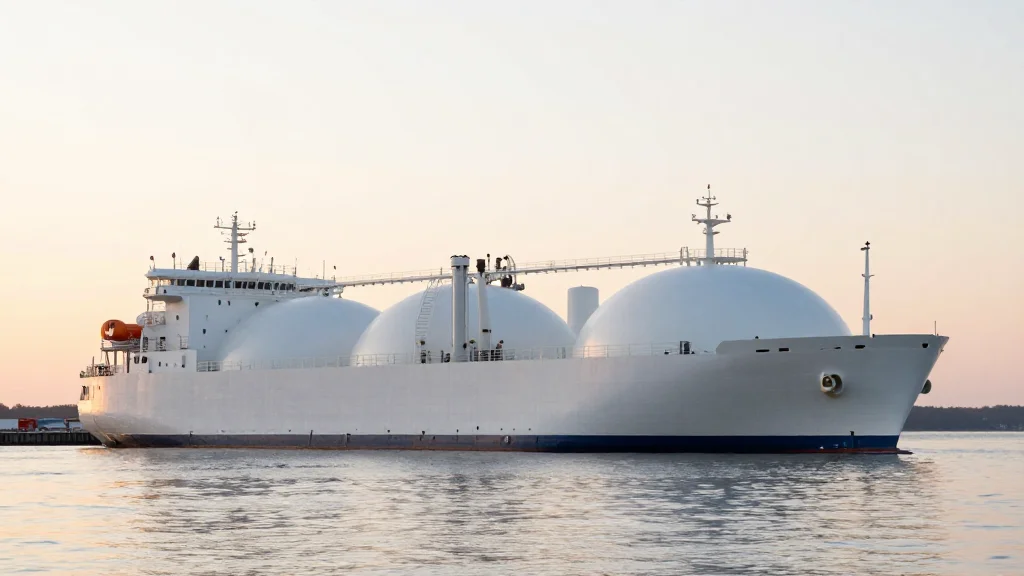
Poland Moves Closer to Second LNG Terminal with FSRU Launch
Why It Matters
The new FSRU expands Poland’s import capacity and diversifies supply sources, enhancing energy security and positioning the country as a key European gas hub.
Key Takeaways
- •HD Hyundai launched FSRU for Poland's Gdańsk LNG terminal.
- •First phase adds 6.1 Bcm annual capacity, fully booked by Orlen.
- •Potential second phase could raise capacity by 4.5 Bcm.
- •LNG expected to become majority of Poland's gas imports by 2028.
- •Project bolsters Poland's position as a Central European energy hub.
Pulse Analysis
Poland’s push to broaden its liquefied natural gas (LNG) infrastructure reflects a broader European trend toward supply diversification amid geopolitical uncertainty. By opting for a floating storage and regasification unit (FSRU), the country sidesteps the lengthy construction timelines of on‑shore facilities while leveraging proven maritime technology. The FSRU, built by HD Hyundai in Ulsan, underscores the growing partnership between European energy firms and Asian shipbuilders, a dynamic that accelerates project delivery and reduces capital exposure.
The Gdańsk terminal’s first phase, slated for Q1 2028, will inject 6.1 billion cubic metres of gas annually into Poland’s market, a volume already contracted by state‑controlled oil giant Orlen. This commitment guarantees immediate revenue streams and mitigates market risk. Should Gaz‑System green‑light the second phase, total capacity could climb to roughly 10.6 Bcm, narrowing the gap between domestic consumption—projected at 19.6 Bcm in 2025—and import needs. The shift toward LNG also rebalances Poland’s energy mix, with the fuel poised to eclipse pipeline deliveries and become the dominant import source.
Strategically, the expanded LNG capability cements Poland’s ambition to serve as a Central European energy hub. Enhanced import capacity enables the country to re‑export surplus gas via interconnectors to Germany, the Czech Republic, Lithuania and Slovakia, reinforcing the EU’s collective energy resilience. Moreover, the project aligns with Warsaw’s broader goal of reducing reliance on single‑source pipelines, thereby strengthening bargaining power in future gas contracts. As the Baltic Sea region evolves into a competitive LNG corridor, Poland’s FSRU‑based terminal positions it at the forefront of the next wave of European energy security initiatives.
Poland moves closer to second LNG terminal with FSRU launch
Comments
Want to join the conversation?
Loading comments...