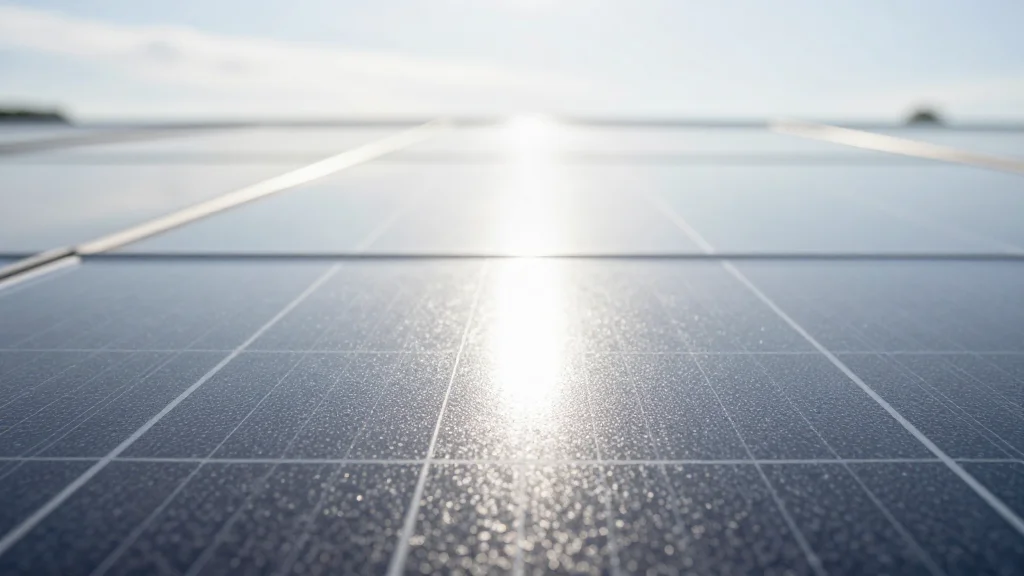
Porous Silica-Based Anti-Reflective Coating Increases PV Glass Optical Transmission by 5.2%
Why It Matters
Even modest optical gains translate into significant energy yield increases for large‑scale PV farms, while durability ensures the coating survives years of outdoor exposure, making the technology commercially viable.
Key Takeaways
- •5.2% transmission boost achieved on porous silica coating
- •Optimal formula: 2% Pluronic, 70:30 TEOS:MTES ratio
- •15‑minute calcination improves abrasion resistance versus 1‑hour
- •Increased porosity lowers refractive index, enhancing anti‑reflective performance
- •Future work targets double‑layer coating for durability and anti‑soiling
Pulse Analysis
Anti‑reflective (AR) coatings are a cornerstone of modern photovoltaic (PV) module design, where every fraction of a percent in light transmission can affect annual energy output. Traditional AR layers often sacrifice durability for optical performance, limiting their lifespan under harsh field conditions. The CIEMAT breakthrough, delivering a 5.2% boost in transmission and approaching 100% transmittance at key wavelengths, represents a rare convergence of high optical efficiency and practical robustness, positioning it as a potential new standard for utility‑scale solar installations.
The research hinges on a sol‑gel chemistry that precisely controls porosity through the TEOS:MTES precursor ratio and the amount of Pluronic P‑123 surfactant. Higher MTES content introduces organic groups that reduce the refractive index, while the surfactant creates nanoscale pores that further lower reflectivity. Crucially, the team discovered that extending the calcination time to one hour, despite improving crystallinity, erodes mechanical strength in highly porous films. A shorter 15‑minute heat treatment preserves abrasion resistance, demonstrating the delicate balance between processing conditions and end‑use performance.
For the solar industry, a coating that simultaneously offers near‑perfect light transmission and long‑term durability could shave years off the levelized cost of electricity (LCOE) for new plants. The upcoming double‑layer approach—pairing a hard, anti‑soiling outer skin with the ultra‑transparent inner layer—addresses both soiling losses and mechanical wear, two persistent challenges for PV operators. As manufacturers evaluate scaling this technology, the findings underscore the importance of material‑level optimization in driving next‑generation efficiency gains across the renewable energy market.
Porous silica-based anti-reflective coating increases PV glass optical transmission by 5.2%
Comments
Want to join the conversation?
Loading comments...