Researchers Develop 3D-Printed Graphene Oxide Electrodes for High-Density Energy Storage
Why It Matters
This breakthrough enables high‑energy, high‑power storage devices without sacrificing cycle life, addressing a key bottleneck for electric vehicles and grid storage. The ability to print thick, conductive electrodes could accelerate commercialization of next‑generation batteries and ultracapacitors.
Key Takeaways
- •3D‑printed graphene oxide electrodes achieve 4.7 Wh L⁻¹ energy density
- •Interpenetrating architecture eliminates ion dead zones in thick electrodes
- •Multi‑material microstereolithography prints up to 4 mm thick electrodes
- •Devices sustain over 7,500 charge cycles with stable performance
- •Platform merges material science with computational design for next‑gen storage
Pulse Analysis
The race for higher‑energy, faster‑charging storage devices has long been constrained by a simple geometric dilemma: thicker electrodes store more charge but impede ion movement, leading to voltage loss and heat. Conventional slurry‑cast batteries rely on flat, slab‑like layers that leave large portions of active material underutilized. Graphene oxide, with its exceptional conductivity and mechanical flexibility, offers a way to redesign the internal architecture of electrodes. By integrating this nanomaterial into additive manufacturing, researchers can break the trade‑off that has limited both energy density and power delivery in electrochemical systems.
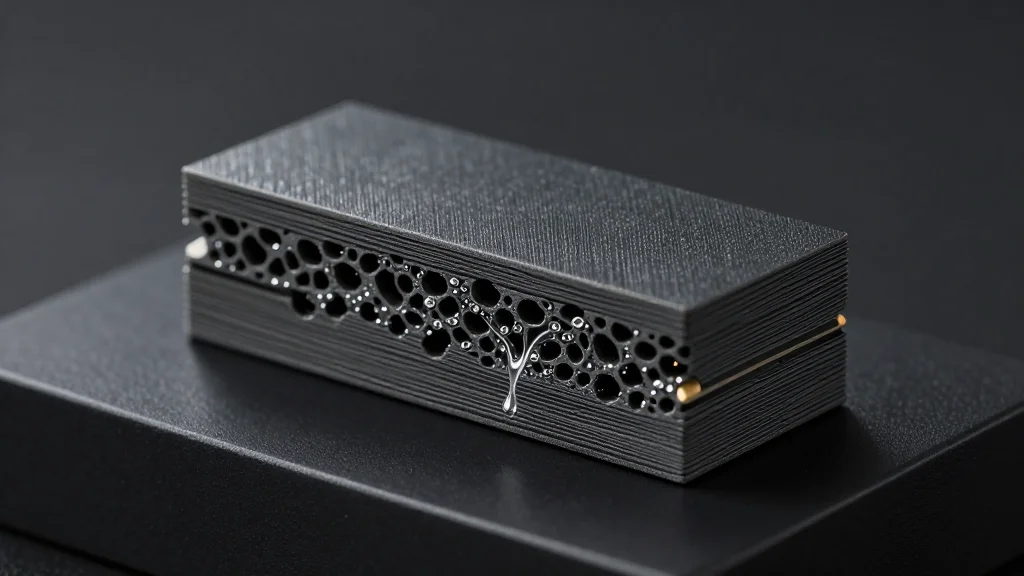
The team at Lawrence Livermore and Berkeley National Laboratories combined an acrylate‑based resin with graphene oxide and employed multi‑material microstereolithography (PµSL) to print interpenetrating electrode structures up to 4 mm thick—almost the full height of a 5.8 mm cell. A porous graphene scaffold provides continuous ion pathways, while a thin gold coating ensures electronic conductivity throughout the bulk. The resulting supercapacitors deliver 4.7 Wh L⁻¹ at 1,689 W L⁻¹ and retain performance over more than 7,500 cycles, outperforming traditional carbon‑based 3D‑printed designs.
Beyond the laboratory, this graphene‑enabled printing platform signals a shift toward co‑engineered material‑structure solutions for next‑generation batteries and ultracapacitors. By coupling computational optimization with printable nanocomposites, manufacturers could produce bespoke electrode geometries tailored to specific power‑energy profiles, reducing material waste and accelerating time‑to‑market. The approach also aligns with emerging trends in electric‑vehicle range extension and grid‑scale storage, where high volumetric energy density and long cycle life are paramount. As scaling and cost‑reduction pathways mature, graphene‑based additive manufacturing may become a cornerstone of sustainable energy infrastructure.
Researchers develop 3D-printed graphene oxide electrodes for high-density energy storage
Comments
Want to join the conversation?
Loading comments...