Energy News and Headlines
  • All Technology
  • AI
  • Autonomy
  • B2B Growth
  • Big Data
  • BioTech
  • ClimateTech
  • Consumer Tech
  • Crypto
  • Cybersecurity
  • DevOps
  • Digital Marketing
  • Ecommerce
  • EdTech
  • Enterprise
  • FinTech
  • GovTech
  • Hardware
  • HealthTech
  • HRTech
  • LegalTech
  • Nanotech
  • PropTech
  • Quantum
  • Robotics
  • SaaS
  • SpaceTech
AllNewsDealsSocialBlogsVideosPodcastsDigests

Energy Pulse

EMAIL DIGESTS

Daily

Every morning

Weekly

Sunday recap

NewsDealsSocialBlogsVideosPodcasts
EnergyNews‘Reversible Solid Oxide Fuel Cells’: Noon Energy’s Approach to 100+ Hour Energy Storage
‘Reversible Solid Oxide Fuel Cells’: Noon Energy’s Approach to 100+ Hour Energy Storage
Energy

‘Reversible Solid Oxide Fuel Cells’: Noon Energy’s Approach to 100+ Hour Energy Storage

•February 5, 2026
0
Energy Storage News
Energy Storage News•Feb 5, 2026

Why It Matters

The solution offers high‑density, multi‑day storage at lower incremental cost, directly addressing renewable intermittency and reducing dependence on fossil‑fuel baseload generation.

Key Takeaways

  • •Demonstration project operational, targeting 100+ hour storage.
  • •Energy density 20‑50× typical flow batteries, rivaling pumped hydro.
  • •Cost scaling flat by adding storage tanks, not extra cells.
  • •Targets data centers, microgrids, utility‑scale, high‑rate C&I customers.
  • •Uses proven solid oxide fuel cell tech in reversible mode.

Pulse Analysis

Long‑duration energy storage (LDES) has become a bottleneck for deep renewable integration, as most batteries excel at short‑term balancing but struggle beyond a few hours. Noon Energy’s reversible solid oxide fuel cell system sidesteps this limitation by storing energy chemically in a carbon‑based liquid, similar to flow batteries, while leveraging the high‑temperature efficiency of solid oxide technology. This hybrid approach creates a new class of storage that can bridge multi‑day gaps, a capability increasingly demanded by grid operators and large‑scale renewable projects.

The technical edge of Noon’s design lies in its extraordinary energy density—claimed to be 20 to 50 times higher than typical flow batteries and comparable to pumped‑hydro storage, yet compressed into a footprint 100 times smaller. Because the power block remains constant, additional storage is achieved simply by enlarging the electrolyte tanks, keeping marginal costs almost flat. This contrasts sharply with lithium‑ion systems, where capacity growth requires duplicating expensive cell stacks, inflating both capital expense and supply chain complexity. Moreover, the use of mature solid oxide fuel cell hardware, already proven in natural‑gas power plants, reduces development risk and accelerates commercialization.

Market interest is already materializing across four key segments: hyperscale data centers driven by AI workloads, commercial‑industrial behind‑the‑meter users facing high electricity rates, remote microgrids reliant on diesel, and utility‑scale grid projects seeking firm, low‑cost storage. By offering a compact, high‑density solution that can be deployed virtually anywhere, Noon Energy positions itself to capture a sizable share of the projected $200 billion LDES market. If the technology scales as promised, it could dramatically lower the cost of firming renewable generation, hastening the transition to a carbon‑free electricity system.

‘Reversible solid oxide fuel cells’: Noon Energy’s approach to 100+ hour energy storage

By April Bonner · February 5, 2026

Energy‑Storage.news speaks with Noon Energy co‑founder and CEO Chris Graves about the company’s approach to long‑duration energy storage.

In January, Noon Energy launched its first operational demonstration project. The company describes its battery technology as “ultra‑long‑duration” and “multi‑day” energy storage. It asserts that its system can fill long‑lasting gaps in renewable energy supply, reducing reliance on traditional “baseload” energy from coal, gas, and other thermal generation.

The battery functions similarly to a flow battery, storing energy in liquid electrolyte tanks separate from the power stack. The Noon fuel‑cell battery likewise enables decoupling of power and energy.

Noon Energy’s battery consists of three main parts:

  1. Power block – uses reversible solid oxide fuel cell (SOFC) technology to convert electricity into stored energy.

  2. Charge tank – transforms electricity into a carbon‑based storage medium while releasing oxygen into the air.

  3. Discharge tank – takes in oxygen from the air to convert stored energy back into electricity.

Noon claims that this process is clean and efficient, utilizing readily available materials.

“In our case, we have a significantly higher energy density—up to 50 times greater than a typical flow battery and even surpassing pumped hydro water storage. That’s the main distinction in the concept. We are utilizing existing industry technology that already produces solid oxide fuel cells for natural‑gas power generation. In our application, the same technology is used in a reversible manner: it charges in one mode and discharges in fuel‑cell mode, which is how we operate,” Graves explains.

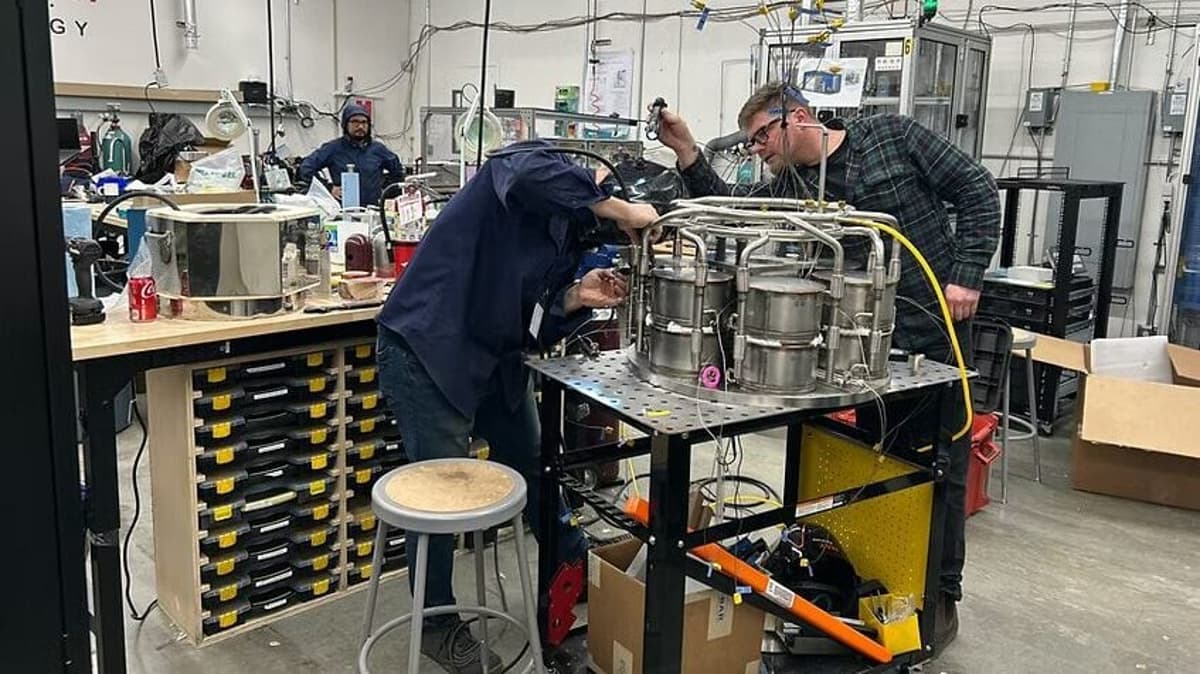
Noon Energy’s cells

Graves explains that the design allows energy capacity to be increased simply by adding tank capacity, which is far less expensive than duplicating entire cells as with conventional lithium‑ion batteries.

“(The design) means that you can add energy capacity by just adding the tank capacity. That’s very inexpensive compared to duplicating the entire cells, for example, for a regular type of lithium‑ion (Li‑ion) battery.”

He notes that with lithium‑ion batteries, capacity is increased by duplicating cells, which changes the cost and performance scaling. In contrast, Noon’s approach keeps costs “nearly flat” as the system scales.

Market applications

The development of Noon Energy’s technology aligns with a global surge in demand for reliable, long‑duration energy storage (LDES). Graves highlights strong interest from hyperscale data centres driven by the AI boom, where “they want a lot of power, and of course, a lot of that is natural gas. Turbine prices are increasing. There are long lead times.”

Beyond data centres, Noon has identified four primary market segments:

  • Hyperscale and industrial load expansion

  • Commercial and industrial (C&I) behind‑the‑meter (BTM) customers paying high electricity rates

  • Microgrids and island situations dependent on costly diesel generation

  • Utility‑scale grid projects

“We also have commercial, industrial behind‑the‑meter customers quite interested if they’re paying high rates, whether that’s just the base electricity rates, or adding in some demand charges and maybe replacing a backup generator as well. So, we can offer a solution that saves money for them,” Graves says.

Compared with current LDES solutions, Noon’s technology offers a unique size advantage. Graves describes the system as “ultra‑compact, 100 times smaller, and deployable anywhere,” unlike pumped hydro energy storage, which is geographically limited.

The energy density advantage is significant:

“Our energy density is 20 to 50 times higher than a typical flow battery.”

Higher energy density enables smaller footprints, reducing shipping, delivery, and installation costs.

Leveraging proven technology

Rather than creating entirely new technology, Noon builds on established solid oxide fuel cell systems that already have a substantial operational history in natural‑gas power generation.

“We are leveraging that solid oxide fuel cell technology as the core tech. So that does have a lot of operational history. I think a couple of gigawatts or so are out there doing the fuel‑cell natural‑gas power generation application,” Graves explains.

Noon’s go‑to‑market strategy emphasizes strategic partnerships with project developers, allowing the company to focus on its core technology while partners handle site work, interconnection, and construction.

Vision for the energy transition

Graves articulates an ambitious vision for the technology’s role in the global energy transition:

“In the big picture, I do think that, especially solar power, would be the dominant electricity supply in the world, and that would include data‑centre applications. We would help that continue by being able to make it fully reliable and firm, which is the big issue, right?”

With demonstration projects underway and commercial systems in development, Noon Energy presents a potentially transformative approach to solving the intermittency challenge that has limited renewable energy’s grid penetration.

Read Original Article
0

Comments

Want to join the conversation?

Loading comments...