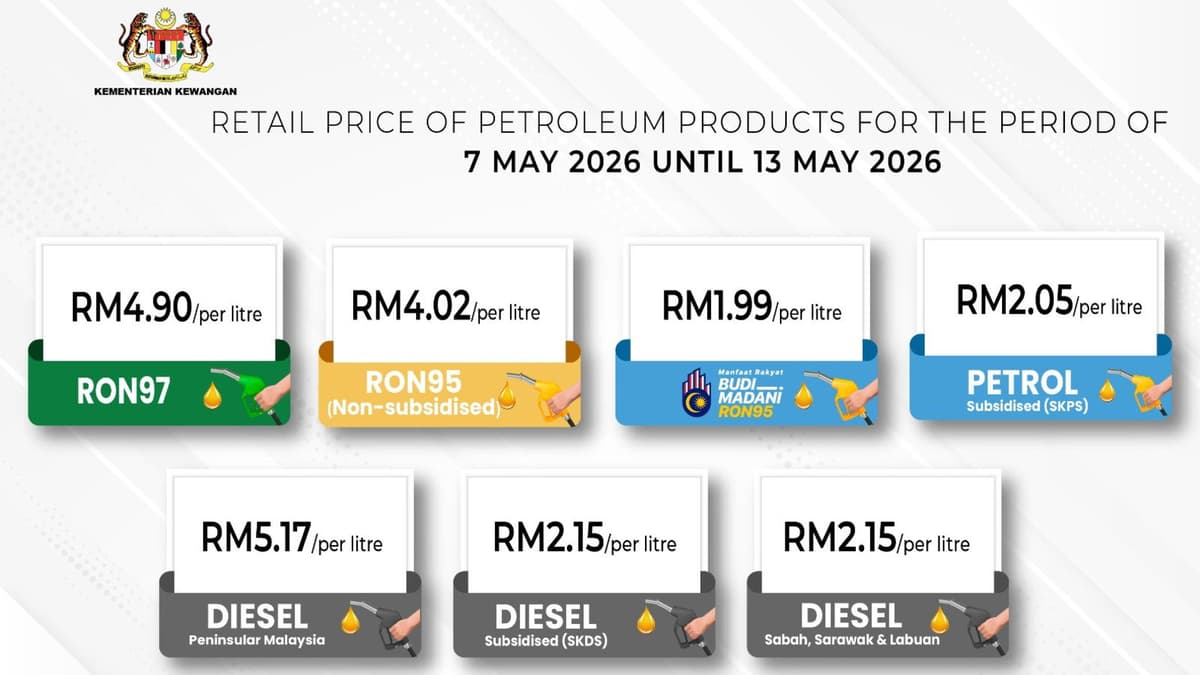
RON95 and Diesel Prices up RM0.05/litre, Subsidised Petroleum Prices Maintained From 7-13 May
Why It Matters
Higher retail fuel costs pressure household budgets and transport‑heavy sectors, while maintained subsidies soften the impact and signal government commitment to social stability.
Key Takeaways
- •RON95 rises 5 sen to RM4.02 ($0.88) per litre
- •Diesel climbs 5 sen to RM5.17 ($1.14) per litre
- •Subsidised fuel prices stay unchanged, cushioning consumers
- •MOF cites West Asia conflict driving global oil prices above $100/barrel
- •No price change for RON97, remains RM4.90 ($1.08) per litre
Pulse Analysis
The modest 5‑sen hike in Malaysia’s RON95 and diesel prices underscores how tightly the nation’s fuel pricing is tethered to volatile global oil markets. With Brent crude hovering above the $100‑per‑barrel threshold, the Automatic Pricing Mechanism automatically adjusts retail rates based on weekly averages. While the increase translates to roughly $0.02‑$0.03 per US gallon, it nonetheless nudges transport costs higher for logistics firms, ride‑hailing services, and commuters, potentially feeding into broader inflationary pressures.
Malaysia’s decision to keep subsidised fuel rates steady reflects a delicate balancing act between fiscal prudence and social welfare. By locking BUDI95 at RM1.99 ($0.44) and diesel subsidies at RM2.15 ($0.47), the Ministry of Finance aims to shield low‑income households and essential industries from price shocks. These subsidies, however, represent a notable fiscal outlay, prompting policymakers to monitor demand elasticity and consider longer‑term reforms such as targeted cash transfers or a gradual phase‑out as the global supply stabilises.
Looking ahead, the trajectory of Malaysian fuel prices will hinge on geopolitical developments in West Asia and the pace of OPEC‑plus production adjustments. Any de‑escalation could ease crude premiums, allowing the government to pause further retail hikes. Conversely, renewed supply disruptions may force additional adjustments, testing the resilience of both consumers and the nation’s fiscal buffers. Stakeholders should therefore track oil market sentiment, exchange‑rate movements, and domestic consumption trends to anticipate the next pricing cycle.
RON95 and diesel prices up RM0.05/litre, subsidised petroleum prices maintained from 7-13 May
Comments
Want to join the conversation?
Loading comments...