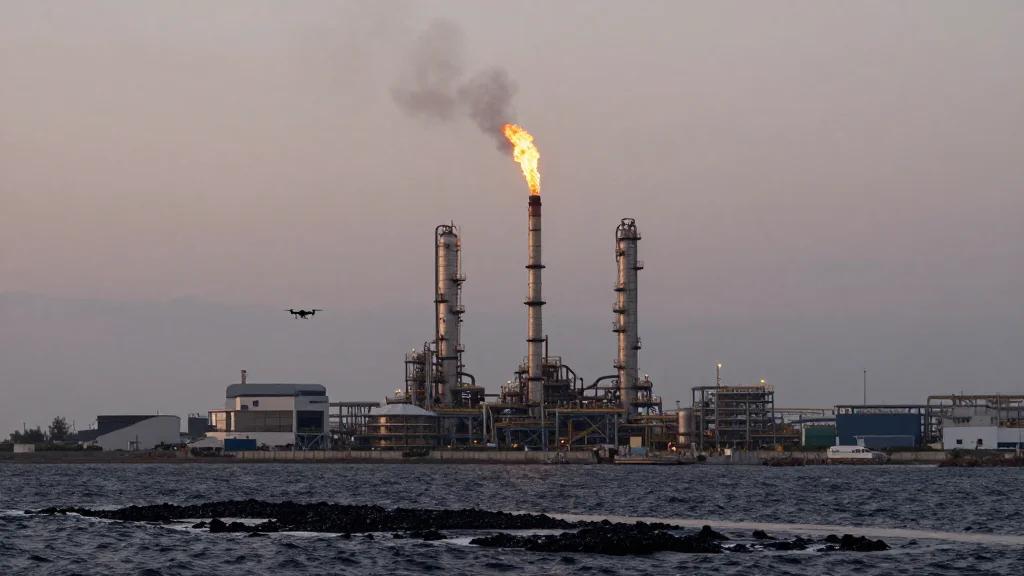
Second Drone Strike Hits Russia’s Tuapse Refinery, Sparks Oil Spill in Black Sea

Why It Matters
The Tuapse attacks illustrate how the Ukraine‑Russia conflict is spilling over into critical energy infrastructure, threatening both regional supply chains and global oil markets. Repeated disruptions at a major Black Sea export hub could force Russia to reroute shipments, tightening global supply and supporting higher oil prices at a time when markets are already volatile due to geopolitical tensions in the Middle East. Beyond market dynamics, the oil spill raises environmental concerns for the Black Sea, a body already stressed by pollution and overfishing. A failure to contain the spill could damage fisheries, tourism and coastal livelihoods, adding a humanitarian dimension to the strategic calculus of the conflict.
Key Takeaways
- •Ukraine launched a second drone strike on the Rosneft‑owned Tuapse refinery and export terminal, killing at least one person.
- •The attack ignited multiple fires and damaged a gas pipeline, a church and two schools in the Tuapse area.
- •An oil spill of about 10,000 square meters was detected 1.5 miles from the port, prompting deployment of 750 m of containment booms and specialized recovery equipment.
- •Tuapse processes roughly 5‑6 million tonnes of oil annually, making the facility a linchpin in Russia’s Black Sea export network.
- •Repeated strikes could force Russia to shift exports to overland routes, tightening global oil supplies and supporting higher Brent crude prices.
Pulse Analysis
The twin attacks on Tuapse signal a maturing Ukrainian drone campaign that targets not just military assets but also revenue‑generating infrastructure. By hitting a refinery that feeds directly into Russia’s Black Sea export corridor, Kyiv is applying economic pressure that complements battlefield gains. Historically, energy chokepoints have been leveraged as bargaining chips in conflicts; the Tuapse strikes revive that playbook in a modern, unmanned‑aircraft context.
From a market perspective, the immediate impact is modest—Russia still has ample oil reserves and alternative export routes. However, the psychological effect on traders is outsized. Each successful strike chips away at the perception of Russian supply reliability, prompting risk‑averse investors to price in a premium for Russian crude. If the pattern continues, we could see a structural shift where European refiners accelerate diversification away from Russian feedstock, accelerating the long‑term decline of Russia’s market share in Europe.
Environmentally, the spill underscores a neglected side effect of the war: ecological damage in secondary theaters. The Black Sea’s limited circulation means pollutants linger, threatening marine life and coastal economies. International response mechanisms are weak, leaving remediation largely to Russian authorities, whose capacity may be stretched by ongoing sanctions and war expenditures. This creates a potential flashpoint for future diplomatic disputes, especially if neighboring states or NGOs demand accountability.
Looking ahead, the key variables will be the frequency of such attacks, Russia’s ability to harden its facilities, and the willingness of Western partners to supply Ukraine with longer‑range drones. If Ukraine can sustain pressure on Tuapse and similar hubs, the cumulative effect could be a measurable dent in Russia’s oil export earnings, reshaping the energy‑war nexus for years to come.
Second Drone Strike Hits Russia’s Tuapse Refinery, Sparks Oil Spill in Black Sea
Comments
Want to join the conversation?
Loading comments...