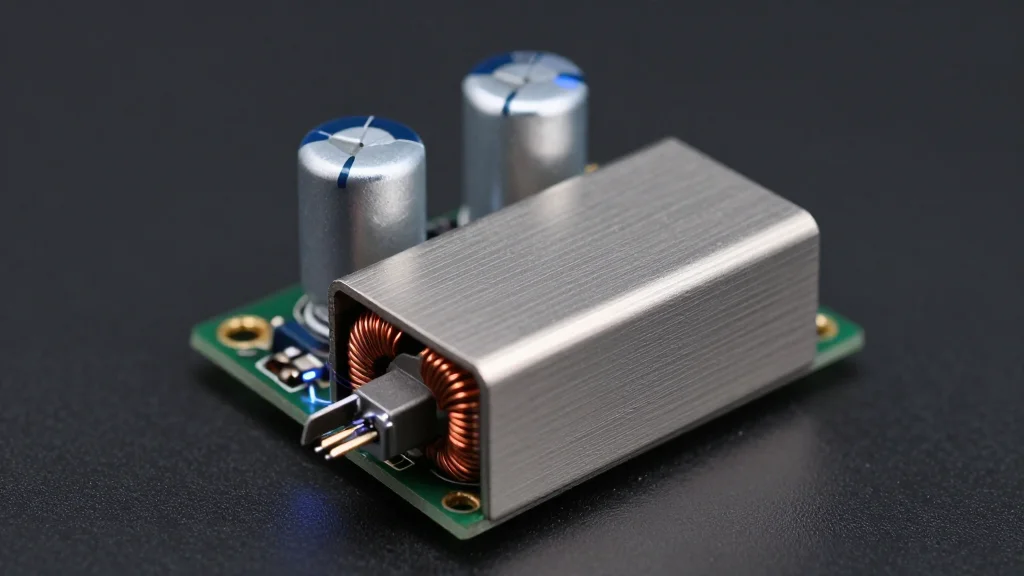
Single Switch High Gain DC-DC Quadratic Boost Converter for Renewable Energy Applications
Why It Matters
The converter’s high gain and near‑unity efficiency enable smaller, cheaper inverter designs for solar and micro‑grid deployments, accelerating cost‑effective renewable integration.
Key Takeaways
- •Prototype delivers 11.17× voltage gain at 28% duty cycle
- •Single‑switch design cuts component stress and switching losses
- •Full‑load efficiency reaches 96% for 200 W output
- •Reduced diode voltage stress simplifies thermal management
- •Compact topology suits PV inverters and micro‑grid applications
Pulse Analysis
In the drive toward greener electricity, power‑electronic converters are the unsung workhorses that translate raw energy into grid‑ready power. Traditional boost converters often require multiple switches or large transformer ratios to reach the high voltages needed for photovoltaic (PV) strings or battery‑storage systems, which inflates component count, size, and losses. Engineers therefore seek topologies that can deliver large voltage multiplication while keeping the circuit simple, reliable, and efficient. A single‑switch solution that can achieve double‑digit gain without sacrificing performance would represent a meaningful step forward for the industry.
The paper by Chakraborty, Tewari and colleagues proposes exactly that—a quadratic boost converter built around a single MOSFET, an input‑side voltage‑lifting capacitor (VLC) network, an intermediate LCL stage, and an output switched‑capacitor (SC) bank. This arrangement multiplies the input voltage by more than eleven times while the duty cycle stays below 30 %, dramatically reducing switching stress on the MOSFET. Experimental hardware delivering 200 W at 380 V demonstrated a peak voltage gain of 11.17× and a full‑load efficiency of 96 %, outperforming many multi‑switch alternatives. The reduced voltage stress also eases diode selection and thermal design, contributing to the high overall efficiency.
For solar inverter manufacturers and micro‑grid developers, the ability to achieve high step‑up ratios with a single active switch translates into lower bill‑of‑materials, smaller footprints, and improved reliability—key drivers of cost reduction in renewable deployments. The 96 % efficiency at 200 W suggests that scaling the topology to kilowatt‑class modules could retain comparable performance, making it attractive for residential and commercial PV installations where space is at a premium. Moreover, the simplified gate‑drive requirements ease integration with digital control platforms, opening pathways for smarter, grid‑interactive converters that can adapt to fluctuating generation and demand.
Single Switch High Gain DC-DC Quadratic Boost Converter for Renewable Energy Applications
Comments
Want to join the conversation?
Loading comments...