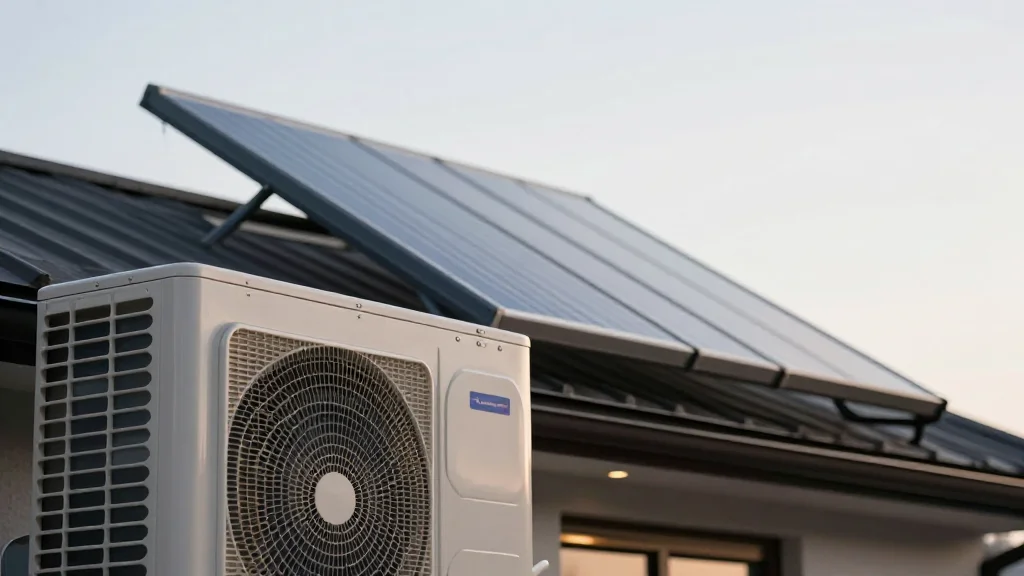
Solar-Assisted Air-Source Heat Pump for Radiant Floor Heating
Why It Matters
The study demonstrates a viable pathway to improve heat‑pump efficiency in harsh, sub‑zero climates, reducing electricity demand and supporting deeper decarbonization of residential heating.
Key Takeaways
- •Integrated solar collector raises ASHP COP from 2‑4 to up to 6.
- •40 m² collector improves annual COP by 7% and cuts 256 kWh electricity.
- •System maintains indoor setpoint >97% of year in -25 °C climate.
- •Larger collectors further boost efficiency but increase auxiliary heater reliance.
- •Thermal storage tank stabilizes water temperature for radiant floor heating.
Pulse Analysis
As climate‑change policies push homeowners toward electrified heating, air‑source heat pumps have become the cornerstone of low‑carbon residential systems. Yet their performance drops sharply when outdoor temperatures plunge, prompting engineers to seek supplemental heat sources. Solar‑assisted heat pumps marry two mature technologies—photovoltaic‑free solar thermal collectors and high‑efficiency compressors—to pre‑condition the incoming air, thereby easing the compressor’s load and preserving COP even when frost threatens conventional units.
The University of Calgary team employed TRNSYS to simulate a 10.5 kW ASHP feeding a 300‑liter thermal storage tank, with an unglazed SAC ranging from 16 to 40 m². By recirculating evaporator exhaust air through the collector whenever it was warmer than ambient, the system harvested daylight heat and raised the evaporator inlet temperature. Results showed a COP uplift from the typical 2‑4 range to as high as 6 during sunny winter periods, translating to a 7% annual COP increase and a 256 kWh electricity reduction—equivalent to roughly $30 in U.S. utility costs. The auxiliary heater remained under 20% of total heating load, confirming that solar pre‑heating can substantially offset electric consumption.
For the residential market, these findings suggest that integrating modest‑size solar air collectors could make heat‑pump retrofits viable in northern latitudes where previously the economics were marginal. Builders and HVAC installers may soon offer packaged solutions that include a compact SAC, a modest thermal storage tank, and smart controls to manage air recirculation. While the added hardware incurs upfront cost, the projected energy savings and extended equipment life could shorten payback periods, especially as electricity rates rise and carbon pricing tightens. Continued field trials will be essential to validate simulation results and to refine control algorithms for real‑world variability.
Solar-assisted air-source heat pump for radiant floor heating
Comments
Want to join the conversation?
Loading comments...