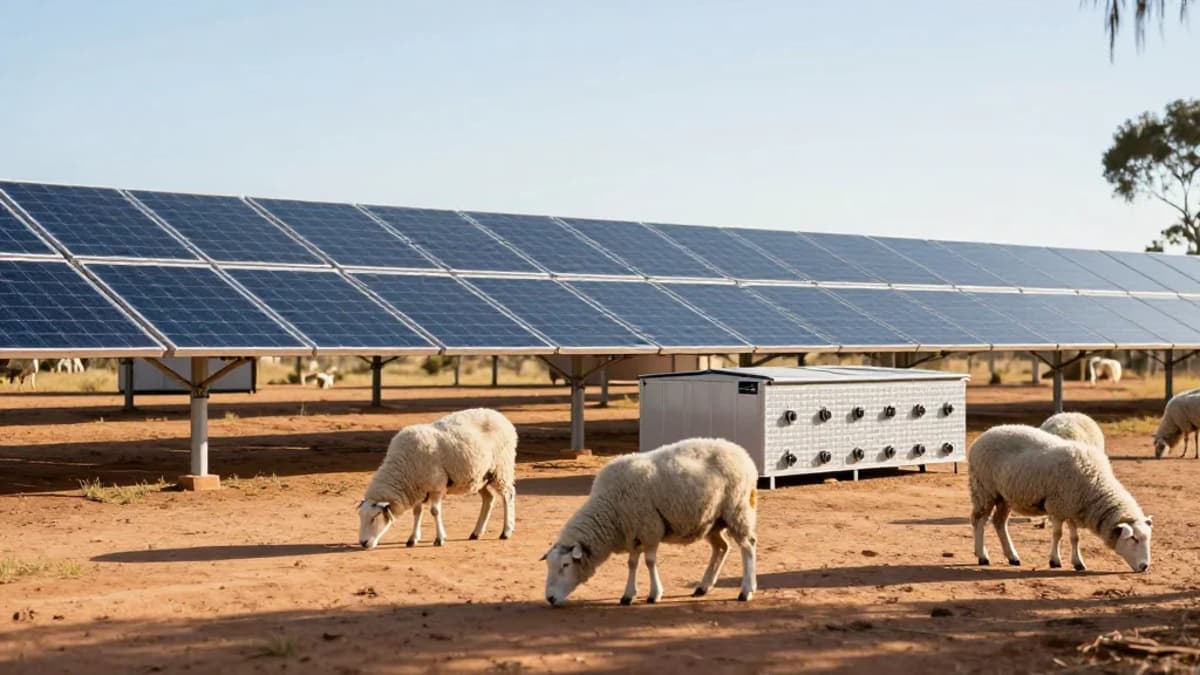
Solar, Storage and Sheep: First Sod Turned at Game-Changing Hybrid PV and Battery Project
•March 10, 2026
0
Why It Matters
By shifting solar output into peak‑price periods, Blind Creek improves grid reliability, reduces reliance on coal and demonstrates a financially viable model for large‑scale renewable storage in Australia.
Key Takeaways
- •300 MW solar paired with 243 MW battery.
- •DC‑coupled design stores daytime solar for evening peaks.
- •Project creates up to 300 full‑time jobs locally.
- •Sheep farming continues alongside renewable infrastructure.
- •$900 million funded by super funds, CEFC, banks.
Pulse Analysis
Blind Creek’s DC‑coupled architecture marks a shift from traditional AC‑linked storage, allowing solar power generated at midday to be captured directly by the battery without conversion losses. This efficiency gain means the plant can release electricity during evening peaks when prices and demand are highest, flattening the supply curve and providing a more predictable revenue stream for investors. The configuration also eases stress on the transmission network by smoothing output, a critical advantage for Australia’s expanding renewable portfolio.
The financing structure underscores a growing consensus among institutional investors, government agencies and banks that large‑scale renewables are low‑risk, long‑term assets. Australian super funds Hostplus and Rest, the Clean Energy Finance Corporation, Westpac and Dutch pension manager APG collectively supplied the $900 million capital, aligning long‑term capital with regional development goals. By integrating the solar‑battery site with existing sheep farms, Octopus Australia preserves agricultural productivity, fostering community acceptance and delivering up to 300 full‑time jobs in the Bungendore‑Monaro area.
Strategically, Blind Creek supports New South Wales’ transition away from aging coal generators by delivering clean electricity to roughly 120,000 homes. Its success could accelerate similar DC‑coupled hybrids across the nation, reinforcing Australia’s 2030 renewable targets and providing a template for policy‑driven, bankable projects. As more utilities adopt storage‑enhanced solar, the market is likely to see increased competition, lower costs, and a reshaped generation mix that prioritises flexibility and sustainability.
Solar, storage and sheep: First sod turned at game-changing hybrid PV and battery project
0
Comments
Want to join the conversation?
Loading comments...