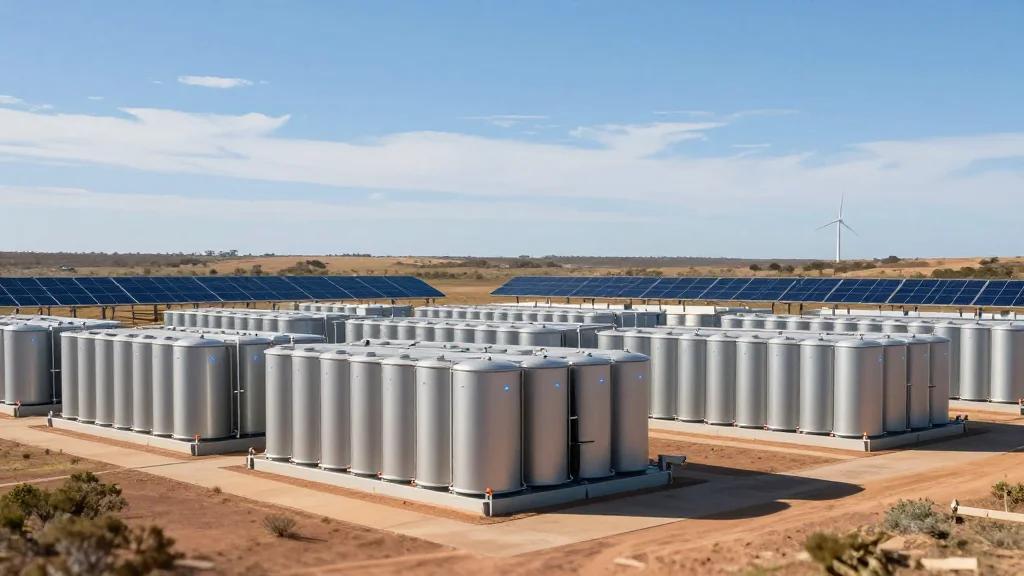
South Australia Begins Construction of 1,000 MWh Battery as 4-Hour Energy Storage System
Companies Mentioned
Why It Matters
The battery will provide critical firming capacity, reducing dependence on gas peakers and accelerating South Australia’s transition to a predominantly renewable electricity system, a model other jurisdictions may emulate.
Key Takeaways
- •250 MW/1,000 MWh battery begins construction in South Australia.
- •Expected 2028 operation will supply four‑hour power to 300,000 homes.
- •Project supports SA’s target of 85% renewable electricity by late 2020s.
- •Battery will reduce reliance on gas peaker plants for grid stability.
- •GenusPlus leads build; CATL supplies modules, Power Electronics provides inverters.
Pulse Analysis
Australia’s renewable surge is increasingly paired with large‑scale storage to address intermittency. South Australia, a global leader in wind and solar penetration, already sources roughly three‑quarters of its electricity from renewables. Yet, without firm capacity, the grid can face stability challenges during low‑wind or night periods. Battery installations like the Reeves Plains Energy Hub are therefore essential, offering rapid response services such as frequency regulation and short‑term load shifting, which historically relied on gas‑fired generators.
The Reeves Plains project introduces a 250 MW, 1,000 MWh lithium‑ion system capable of delivering four hours of continuous power. Built by GenusPlus with CATL’s high‑energy modules and Power Electronics’ inverters, the facility will be operational by 2028 and serve an estimated 300,000 households. While a gas plant remains in the long‑term design, the battery’s firming capability is expected to curtail the plant’s dispatch, lowering emissions and operating costs. The hub exemplifies a hybrid approach, blending stored electricity with flexible generation to smooth renewable output.
Strategically, the hub aligns with South Australia’s policy goal of achieving a net‑100% renewable electricity mix by around 2027. Success could spur additional private investment in storage across Australia’s other states, where similar renewable penetration levels are emerging. Moreover, the project showcases how coordinated government targets, utility commitment, and international supply‑chain partners can accelerate decarbonization. As battery costs continue to fall, such energy hubs are likely to become the backbone of a resilient, low‑carbon grid worldwide.
South Australia Begins Construction of 1,000 MWh Battery as 4-Hour Energy Storage System
Comments
Want to join the conversation?
Loading comments...