Talkative Battery Opens Door to Nano-Enabled Cell Sensing for Safer Energy Storage
Why It Matters
Embedding communication within the power line reduces hardware complexity and cost while delivering real‑time internal temperature data, a critical factor for preventing thermal runaway in high‑energy battery packs.
Key Takeaways
- •Load‑shift keying encodes sensor data onto converter ripple
- •Internal NTC sensor transmitted temperature at 153 bit s⁻¹
- •No extra wiring or antennas required for data transmission
- •Higher signal‑to‑noise achieved with short cable connections
Pulse Analysis
Thermal runaway remains the Achilles' heel of lithium‑ion batteries, especially as manufacturers push cell sizes larger for electric‑vehicle and grid‑scale applications. Conventional external temperature probes often miss rapid core heating because the surface‑to‑volume ratio drops, leaving operators with incomplete data. The industry has therefore been hunting for reliable internal‑sensor solutions that can survive the chemically aggressive environment inside a cell without adding bulky communication hardware.
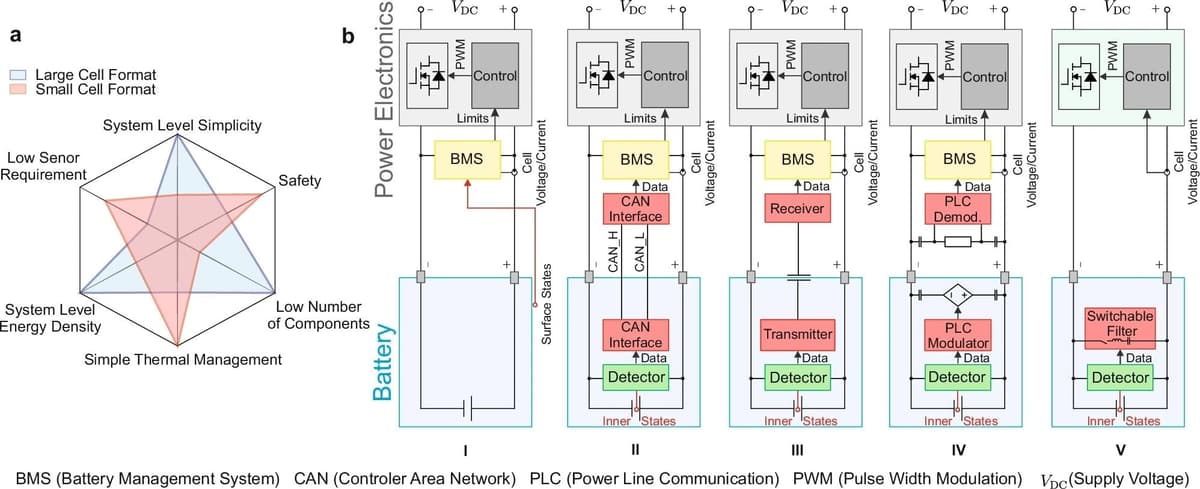
The "talkative battery" concept sidesteps these hurdles by turning a battery's own power‑converter ripple into a data carrier. Using load‑shift keying, a miniature switchable LC resonant circuit toggles the cell’s impedance, imprinting binary temperature information onto the high‑frequency ripple already present during charging. In the study, a simple NTC sensor and microcontroller generated a digital bitstream that was demodulated with a phase‑sensitive detector, achieving a clean 153 bit s⁻¹ link even while the cell drew 10.3 A. Crucially, the LC circuit sits in parallel with the terminals, preserving normal operation and requiring only minimal additional components, which translates to lower bill‑of‑materials and fewer failure points.
For battery manufacturers and pack designers, this approach could reshape safety architectures. By embedding sensor‑communication directly into the power line, large‑format packs gain granular thermal insight without the mass and cost of separate wiring harnesses or wireless transceivers—both of which are problematic in metal‑sealed enclosures. While the prototype showed sensitivity to cable length and required careful tuning, the underlying principle is scalable. Future work will focus on integrating diverse sensor types, automating resonance matching across cell chemistries, and validating the method in full‑scale EV modules. If these challenges are met, load‑shift‑keyed talkative batteries could become a standard safety feature, accelerating the rollout of higher‑energy, more reliable storage solutions.
Talkative Battery Opens Door to Nano-Enabled Cell Sensing for Safer Energy Storage
Comments
Want to join the conversation?
Loading comments...