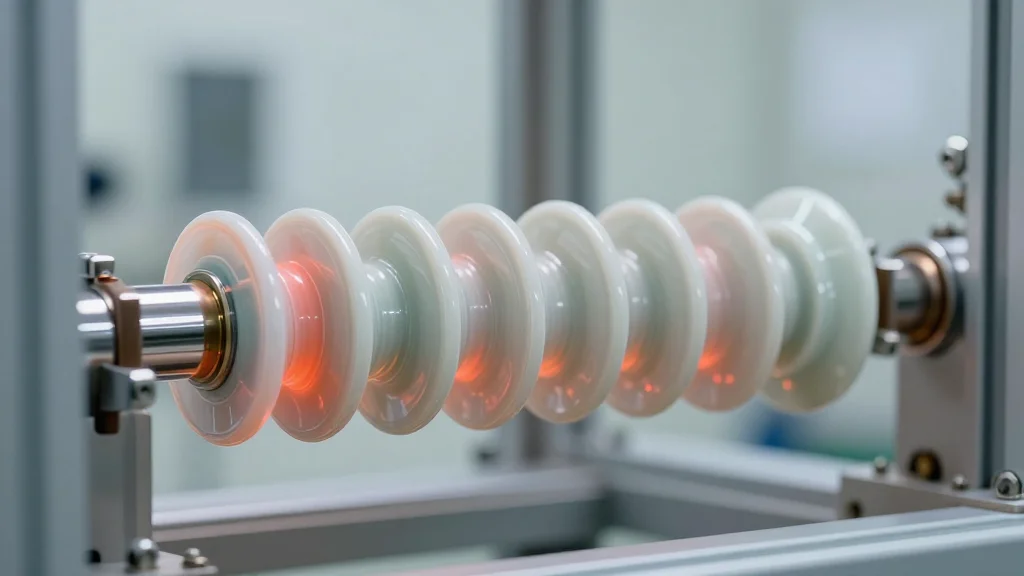
Temperature Rise Characteristics of UHV AC Composite Insulators Under Type Fault Conditions
Why It Matters
Accurate identification of fault‑induced heating enables utilities to prevent insulator failures, reduce outage risk, and optimize maintenance schedules.
Key Takeaways
- •Grading-ring angle 20° raises HV end temperature 6.6%.
- •300 mm shallower insertion increases max temperature 9.3%.
- •Missing grading ring causes 17.3% temperature rise.
- •Umbrella‑skirt damage adds 2‑3 K locally.
- •Surface contamination adds about 1 K temperature increase.
Pulse Analysis
Composite insulators have become the backbone of modern ultra‑high‑voltage (UHV) AC transmission networks because of their lightweight design, high strength, and superior flashover performance. However, their multilayer construction—typically a fiberglass core wrapped in silicone rubber—makes thermal anomalies harder to detect than in traditional ceramic or glass units. Localized overheating can signal mechanical damage, contamination, or electrical stress, yet distinguishing the root cause often requires invasive inspection. The industry therefore relies on indirect indicators such as surface temperature trends, prompting a need for precise, fault‑specific thermal signatures.
The recent UHVAC laboratory experiments provide those signatures by quantifying temperature rise under five representative fault conditions. A 20° grading‑ring deflection produced a 6.6 % rise at the high‑voltage end, while reducing the ring’s insertion depth by 300 mm lifted the peak temperature by 9.3 %. The most dramatic effect—17.3 % increase—occurred when the grading ring was entirely absent, highlighting the ring’s critical role in heat dissipation. Minor defects such as umbrella‑skirt damage and surface contamination added only 2‑3 K and 1 K respectively, yet the sheath‑core rod interface fault generated a persistent hot spot, offering a clear diagnostic cue for field crews.
These quantitative benchmarks empower transmission operators to refine condition‑monitoring algorithms and prioritize inspections based on severity. By integrating the temperature thresholds into infrared scanning protocols, utilities can differentiate between benign contamination and serious structural damage before catastrophic failure. Moreover, the data supports the development of machine‑learning models that classify fault types from real‑time thermal maps, reducing manual analysis time. As UHV networks expand across North America and Asia, adopting such evidence‑based diagnostic tools will enhance reliability, lower maintenance costs, and align with regulatory expectations for grid resilience.
Temperature Rise Characteristics of UHV AC Composite Insulators under Type Fault Conditions
Comments
Want to join the conversation?
Loading comments...