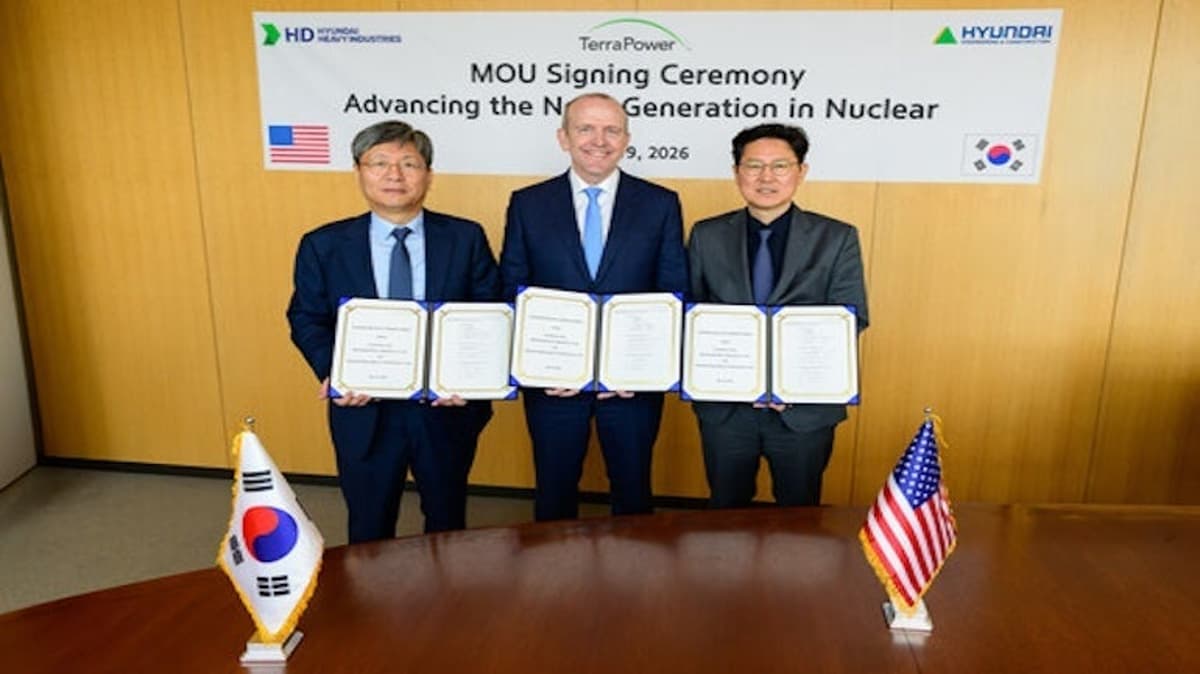
TerraPower Teams up with HD Hyundai on Natrium Reactor Fleet
Companies Mentioned

Why It Matters
The partnership combines U.S. nuclear innovation with Korean manufacturing scale, potentially lowering costs and speeding time‑to‑market for low‑carbon baseload power. Successful rollout could reshape the energy mix as utilities seek resilient, carbon‑free capacity.
Key Takeaways
- •TerraPower partners with HD Hyundai and HDEC for Natrium rollout
- •HD Hyundai will supply reactor enclosure components for serial production
- •Joint roadmap aims to standardize design, financing, and construction
- •Natrium 345 MW reactor can boost to 500 MW with molten‑salt storage
- •Meta contract targets up to eight Natrium units by 2035
Pulse Analysis
The Natrium reactor represents a hybrid of fast‑neutron sodium cooling and molten‑salt energy storage, a combination that promises both high‑temperature efficiency and flexible output. At 345 MW of steady baseload, the system can surge to 500 MW for short periods, addressing peak‑load challenges without the emissions of fossil‑fuel peakers. This design aligns with the Department of Energy’s push for advanced reactors that can integrate with renewable grids, offering a reliable, low‑carbon alternative for utilities grappling with intermittency and rising demand.
TerraPower’s agreements with HD Hyundai Heavy Industries and Hyundai Engineering & Construction create a vertically integrated supply chain that mirrors the automotive model of mass production. HD Hyundai will fabricate the reactor enclosure system, leveraging its large‑scale precision capabilities, while HDEC will co‑manage project financing, engineering, and construction. By standardizing these elements, the partners aim to cut capital expenditures and reduce schedule risk, moving Natrium from pilot projects to a repeatable fleet. The collaboration also signals Korea’s strategic entry into the next‑generation nuclear market, expanding its industrial footprint beyond shipbuilding.
The commercial implications are significant. A Meta‑backed order for up to eight Natrium units by 2035 provides a high‑visibility anchor customer, encouraging other utilities and corporate power purchasers to consider the technology. If the first U.S. demonstration plant reaches operation around 2030 as planned, Natrium could compete with large‑scale battery storage and gas peaker plants on both cost and reliability. Policymakers focused on decarbonization may view the reactor‑storage hybrid as a viable pathway to meet grid resilience targets while keeping emissions near zero.
TerraPower teams up with HD Hyundai on Natrium reactor fleet
Comments
Want to join the conversation?
Loading comments...