TGS Targets Eastern Niger Delta with New 3D Survey
•February 27, 2026
0
Why It Matters
The survey provides the resolution needed to de‑risk Nigeria’s most challenging offshore plays, accelerating exploration and supporting future production growth. It also expands TGS’s multi‑client library, strengthening its strategic position in a key oil‑producing market.
Key Takeaways
- •11,700 sq km 3D survey covers eastern Niger Delta.
- •GeoStreamer dual‑sensor system provides long offsets, wide tow.
- •Data supports PSTM and Q‑PSDM for complex structures.
- •Enhances exploration confidence for deep‑water prospects.
- •Multi‑client library expands TGS presence in Nigeria.
Pulse Analysis
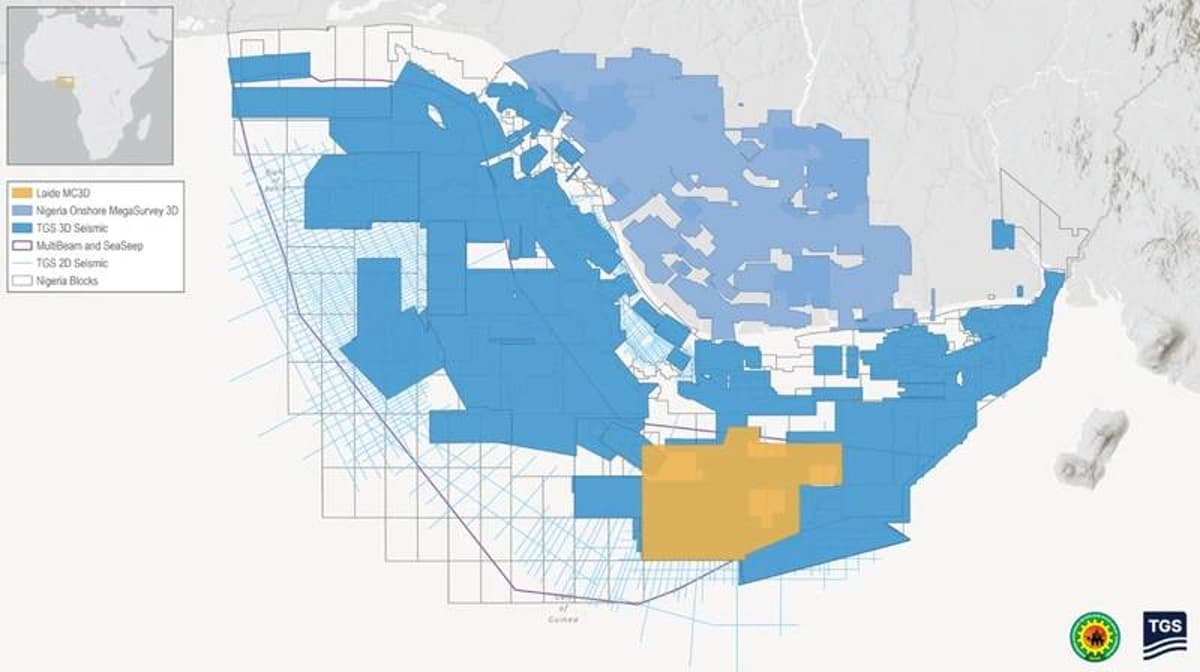
The eastern Niger Delta remains one of Africa’s most prolific hydrocarbon basins, yet its deep‑water zones are riddled with stacked thrusts, anticlines, and shale diapirs that challenge conventional imaging. TGS’s launch of the Nigeria Laide 3D survey, spanning roughly 11,700 sq km, marks a strategic push to de‑risk these frontier plays. By partnering with the Nigerian Upstream Petroleum Regulatory Commission and SeaSeis Geophysical, the project aligns government oversight with cutting‑edge data acquisition, reinforcing Nigeria’s role as a key oil‑exporting nation.
The survey employs TGS’s GeoStreamer dual‑sensor streamer, delivering long offsets and a triple‑source configuration that captures broadband energy across a wide tow. This hardware enables full‑bandwidth pre‑stack time migration (PSTM) and the more sophisticated Q‑pre‑stack depth migration (Q‑PSDM), both of which rely on elastic full‑waveform‑inversion velocity models. For the region’s stacked toe‑thrust structures and elongate anticlines such as Bolia‑Chota, the enhanced resolution reduces positional uncertainty, allowing operators to delineate pay zones and fault systems with unprecedented clarity.
Beyond the technical gains, the Laide 3D adds a high‑fidelity asset to TGS’s multi‑client library, giving a broad spectrum of oil companies immediate access to premium data without bearing acquisition costs. This model accelerates exploration cycles, shortens the time to first‑oil, and can attract new entrants seeking lower‑risk opportunities in Nigeria’s deep water. As global demand for energy transitions, robust seismic insight will be essential for maximizing existing reserves and identifying carbon‑capture‑ready fields, positioning TGS as a pivotal data partner in the region’s evolving energy landscape. The dataset is expected to remain a reference for the next decade.
TGS Targets Eastern Niger Delta with New 3D Survey
0
Comments
Want to join the conversation?
Loading comments...