The Hard Truth About Asia’s Energy Future: Why We Need a New Class of Sovereign Alternatives
Companies Mentioned
Why It Matters
Adding WtE reduces supply‑chain risk, unlocks high‑IRR circular assets, and strengthens energy security for rapidly growing APAC markets.
Key Takeaways
- •APAC generates ~60% of global plastic waste, a prime feedstock for pyrolysis.
- •China supplies 80% of solar panels; risk drives local alternatives.
- •Plasma gasification can turn mixed municipal waste into green hydrogen at scale.
- •Modular WtE units (TRL 7‑9) attract financing more easily than $500M plants.
- •Sovereign‑aligned framework gives 30% weight to waste‑specific feedstock fit.
Pulse Analysis
Asia’s energy outlook is increasingly defined by geopolitical friction and mounting waste volumes. While solar and wind have surged, the region’s dependence on Chinese‑manufactured panels and rare‑earth components exposes projects to tariffs and supply shocks. Simultaneously, Southeast Asia produces millions of tons of rice straw, coconut shells and plastic waste, and urban centers generate costly sewage sludge. Turning these abundant, low‑value streams into energy not only diversifies the fuel mix but also creates a domestic supply chain insulated from external pressures.
Modern waste‑to‑energy technologies have shed the stigma of outdated incineration. Plasma gasification can convert mixed municipal waste into clean syngas, which Indian utilities are already piloting for green hydrogen production. Catalyst‑free pyrolysis offers a low‑cost route to synthetic oil from hard‑to‑recycle plastics, while modular sand‑battery systems enable industrial heat to be stored and reused, enhancing overall plant efficiency. Because these solutions are modular and can be built to TRL 7‑9, they fit the financing profiles of regional banks better than monolithic $500 million plants, accelerating deployment across emerging markets.
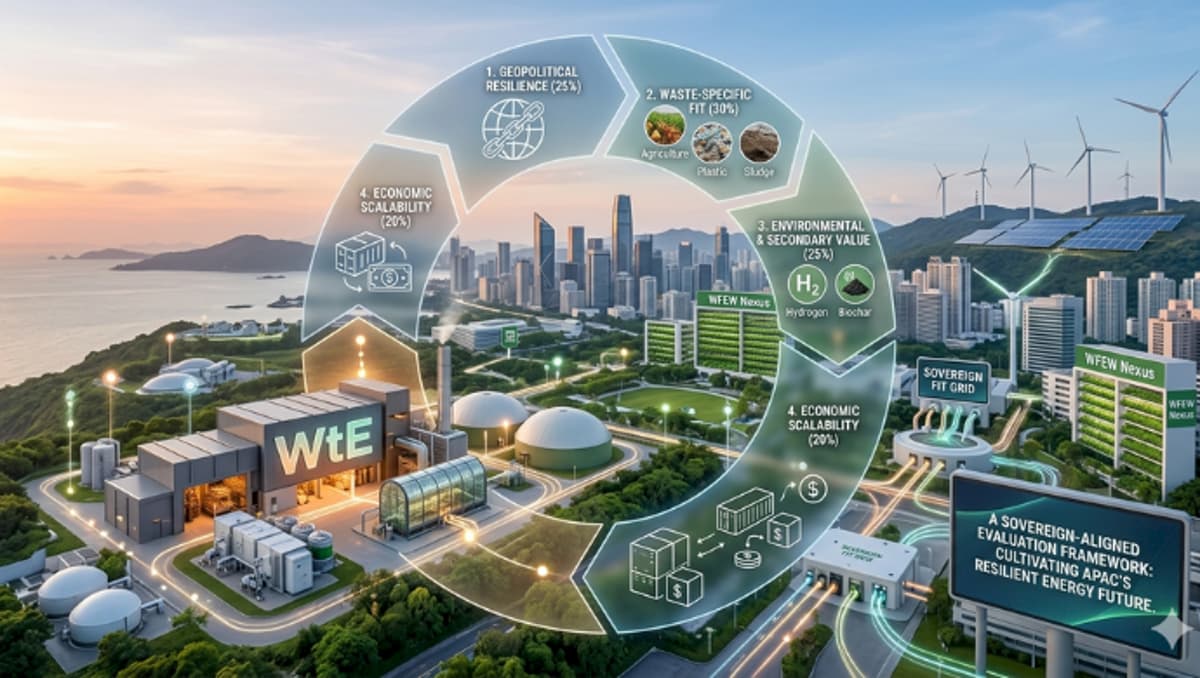
Investors and policymakers are urged to adopt a sovereign‑aligned evaluation framework that prioritises feedstock reliability, geopolitical resilience, circular‑economy returns and agile capital structures. By assigning 30% of project weight to waste‑specific fit and 25% each to risk and secondary value, the framework filters out pilots lacking local relevance while spotlighting high‑IRR opportunities such as hydrogen, bio‑char and rare‑earth recovery. Tailored feed‑in tariffs and supportive regulations—like Indonesia’s recent waste‑to‑energy decree—can further catalyse private capital, positioning WtE as a cornerstone of a resilient, circular energy future for the Asia‑Pacific.
The hard truth about Asia’s energy future: Why we need a new class of sovereign alternatives
Comments
Want to join the conversation?
Loading comments...