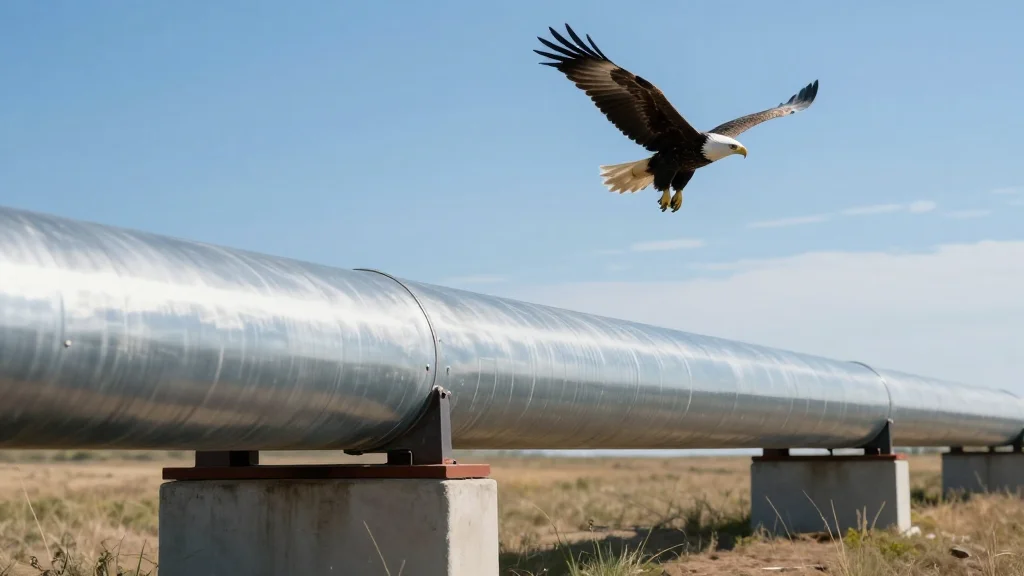
Trump Issues Four Pipeline Permits to Boost US‑Canada Crude Flow

Why It Matters
The permits represent a concrete policy shift toward expanding fossil‑fuel infrastructure at a time when North America’s energy security is a political priority. By easing the movement of Canadian crude into U.S. refineries, the approvals could lower domestic fuel prices, support job creation in construction and operations, and reinforce the United States’ position as a net energy exporter. At the same time, the move intensifies the clash between economic objectives and climate‑policy goals, potentially prompting legal challenges and influencing future trade negotiations between Washington and Ottawa. For investors and market participants, the added pipeline capacity signals a longer‑term commitment to oil production growth, which could affect commodity price forecasts, refinery utilization rates, and the valuation of pipeline operators like Enbridge. The policy also underscores how geopolitical tools—such as tariff threats—are being leveraged alongside infrastructure approvals to shape the bilateral energy relationship.
Key Takeaways
- •President Trump signed four pipeline permits on April 15, including a new construction permit for Bakken Pipeline Company LP.
- •Operational permits were granted to Enbridge Energy, Limited Partnership and Enbridge Pipelines (Southern Lights) L.L.C., updating authorizations from 1991, 1994 and 2008.
- •Permits cover all crude and refined petroleum products except natural gas, aiming to boost U.S.–Canada oil flow.
- •Enbridge recently cleaned up about 60% of a 70,000‑gallon oil spill in Wisconsin, highlighting ongoing environmental concerns.
- •Canada exports 97% of its oil and 100% of its natural gas to the United States, making the permits strategically significant for bilateral trade.
Pulse Analysis
The Trump administration’s rapid issuance of four cross‑border pipeline permits signals a decisive pivot away from the Biden-era emphasis on climate mitigation toward a short‑term focus on energy affordability and geopolitical leverage. By consolidating decades‑old authorizations, the White House reduces regulatory friction, potentially accelerating capital deployment for the Bakken line and related upgrades. This could translate into an incremental capacity boost of up to 300,000 barrels per day, a figure that, while modest relative to the total 2.6 million‑mile network, is enough to ease regional bottlenecks that have historically depressed Canadian crude prices.
From a market perspective, the added capacity may tighten the spread between West Texas Intermediate and Canadian benchmarks, supporting higher U.S. refinery margins. Enbridge, already a dominant conduit for Canadian oil, stands to benefit from renewed operational permits, which could improve its cash flow and justify further dividend hikes. However, the political calculus is fraught: the same administration that is fast‑tracking permits also threatens tariffs, a dual‑track approach that could destabilize investor confidence if trade negotiations sour.
Environmentally, the permits reopen the debate over the viability of expanding fossil‑fuel infrastructure in a decarbonizing world. Legal challenges from NGOs could delay construction, while state‑level climate policies may impose additional compliance costs. The net effect will hinge on whether the administration can reconcile its energy‑security narrative with mounting pressure for emissions reductions, a balancing act that will shape North American energy markets for years to come.
Trump Issues Four Pipeline Permits to Boost US‑Canada Crude Flow
Comments
Want to join the conversation?
Loading comments...