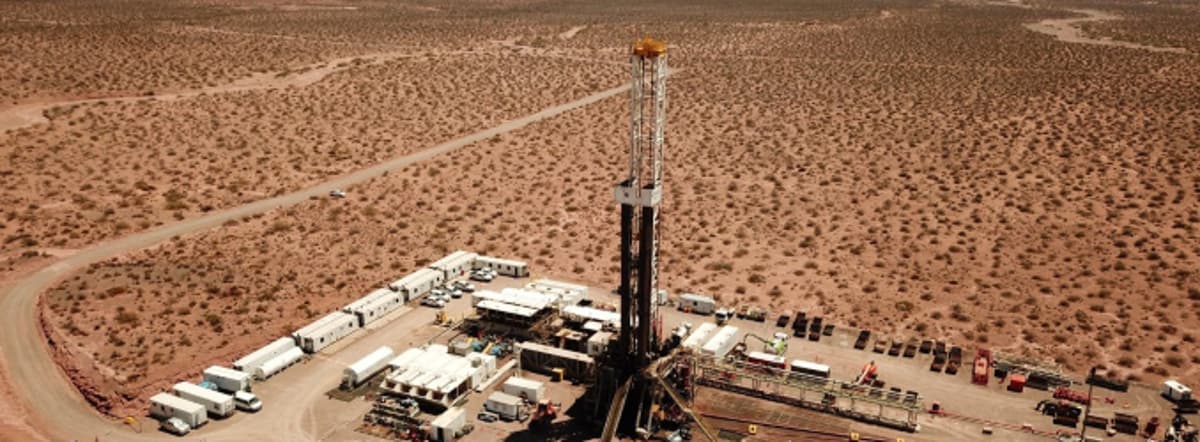
Vaca Muerta Infrastructure Project Nears $1 Billion Financing Package
Companies Mentioned
Why It Matters
The funding unlocks critical export infrastructure, easing gas bottlenecks and boosting hard‑currency inflows that support Argentina’s fragile peso. It also signals confidence from global banks in Milei’s market‑friendly reforms, potentially catalyzing further foreign investment in the country’s shale assets.
Key Takeaways
- •Financing package targets $1 billion for TGS's NGL Project.
- •Project aims to unlock $1.2 billion annual export revenue.
- •Includes 573‑km pipeline linking Vaca Muerta to Atlantic coast.
- •Backed by Citi, JP Morgan, Santander under Milei’s RIGI regime.
- •Project addresses gas bottleneck, supporting shale oil expansion to 1 MMbpd.
Pulse Analysis
Argentina’s Vaca Muerta shale formation has become a magnet for large‑scale energy financing, and the emerging $1 billion loan syndicate for Transportadora de Gas del Sur (TGS) underscores that trend. Global banks such as Citi, JP Morgan and Santander are stepping in to underwrite the NGL Project, a $3 billion venture that combines new gas‑processing units, a 573‑km pipeline to the Atlantic port of Bahía Blanca, and export terminals. By leveraging President Javier Milei’s RIGI regime—offering tax breaks and favorable foreign‑exchange terms—the project aims to generate roughly $1.2 billion in yearly export earnings, positioning it as one of the region’s most ambitious private‑sector infrastructure undertakings.
The core value of the NGL Project lies in its ability to resolve a longstanding bottleneck: the lack of adequate facilities to capture and transport associated gas from shale oil production. As Argentina’s shale output is projected to climb from 600,000 barrels per day today to about 1 million barrels per day by 2030, the need for reliable gas‑liquid pipelines becomes critical. The new pipeline will provide a direct conduit from the inland Vaca Muerta basin to the Atlantic, opening fresh export markets and reducing flaring penalties for operators. This infrastructure not only enhances the economics of shale oil projects but also diversifies Argentina’s energy export portfolio beyond traditional crude shipments.
Beyond the immediate operational benefits, the financing package signals a broader shift in Argentina’s investment climate. Milei’s market‑oriented policies, coupled with the RIGI incentives, are attracting foreign capital to a sector historically hampered by currency controls and fiscal uncertainty. Successful syndication of this loan could pave the way for additional multi‑billion‑dollar projects, such as YPF’s LNG export plan, and reinforce the country’s hard‑currency inflows, which have been vital in stabilizing the peso amid global geopolitical tensions. In sum, the NGL Project not only bolsters Vaca Muerta’s production capacity but also serves as a bellwether for Argentina’s re‑emergence as a competitive energy exporter.
Vaca Muerta infrastructure project nears $1 billion financing package
Comments
Want to join the conversation?
Loading comments...