Viridien Kicks Off Multi-Client OBN Survey in North Sea’s Frigg Area
Why It Matters
The high‑resolution dataset will de‑risk infrastructure‑led exploration and development in the North Sea’s complex geology, giving operators clearer insight for both hydrocarbon and renewable projects.
Key Takeaways
- •645 km² OBN survey spans UK and Norwegian North Sea sectors.
- •Deliverables slated for Q3 2027 using Time‑Lag Full‑Waveform Inversion.
- •Multi‑client data program funded by industry partners reduces individual costs.
- •Enhances structural definition for infrastructure‑led exploration in complex geology.
Pulse Analysis
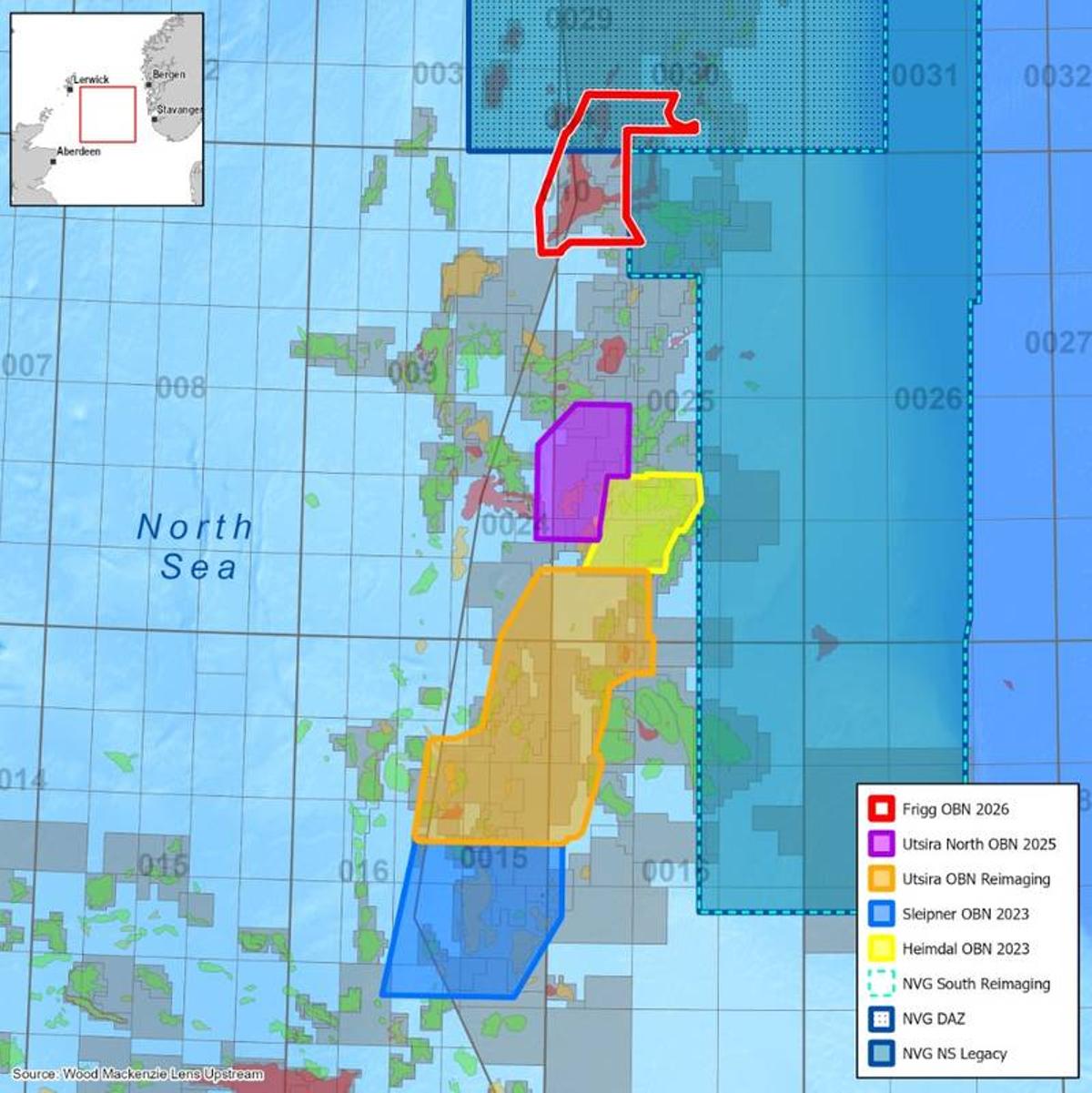
Viridien’s latest ocean‑bottom‑node (OBN) survey in the Frigg area marks a significant expansion of its multi‑client data platform. Covering 645 km² across the United Kingdom and Norway, the project employs the company’s proprietary Time‑Lag Full‑Waveform Inversion (TL‑FWI) workflow, which extracts high‑frequency reflections from raw seismic records to produce ultra‑high‑resolution images of the subsurface. By integrating dense node spacing with advanced inversion algorithms, Viridien can delineate thin stratigraphic layers and fault systems that conventional 2D or 3D surveys often miss, delivering a richer geological picture for downstream users.
The Central North Sea remains a focal point for both hydrocarbon production and emerging offshore infrastructure, such as carbon capture and storage (CCS) hubs and wind‑farm foundations. The Frigg region’s complex fault network and variable reservoir quality have historically challenged exploration teams, making precise imaging essential for de‑risking new wells and planning large‑scale projects. Viridien’s dataset, scheduled for delivery in the third quarter of 2027, promises to sharpen structural definition and improve reservoir characterization, thereby supporting operators seeking to extend field life or repurpose assets for renewable energy.
By structuring the survey as a multi‑client program, Viridien spreads acquisition costs across several industry participants, lowering the financial barrier for individual companies while preserving data exclusivity through tiered licensing. This collaborative model aligns with a broader trend toward shared geophysical assets in mature basins, where data scarcity and budget constraints drive cooperation. As the North Sea transitions toward a lower‑carbon future, high‑quality OBN data will become a strategic commodity, enabling more accurate risk assessments, optimized capital allocation, and faster permitting for next‑generation offshore projects.
Viridien Kicks Off Multi-Client OBN Survey in North Sea’s Frigg Area
Comments
Want to join the conversation?
Loading comments...