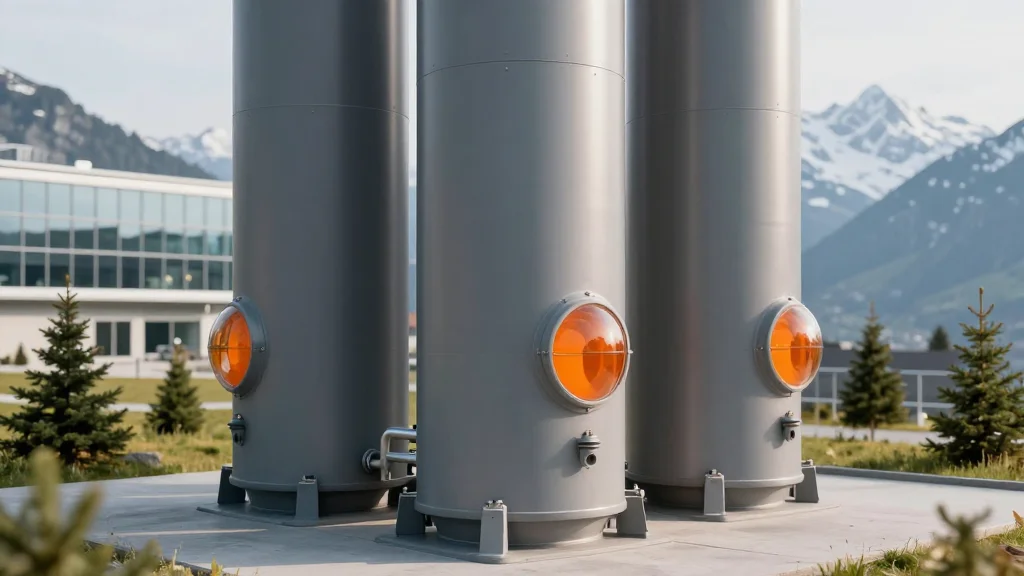
World’s Largest Redox-Flow Battery in Switzerland: Construction Progress on the Laufenburg Megaproject
Why It Matters
By providing fast, large‑scale, non‑flammable storage, the Laufenburg battery strengthens grid reliability and accelerates renewable integration across Europe. Its scale sets a new benchmark for redox‑flow technology, influencing future energy‑storage investments.
Key Takeaways
- •800 MW, 1.6 GWh Redox‑Flow battery under construction in Laufenburg.
- •Final phase targets 1.2 GW power and 2.1 GWh storage capacity.
- •Project can power ~210,000 homes for 24 hours at full capacity.
- •Non‑flammable aqueous electrolyte offers safety and unlimited scalability.
- •Over $1 billion investment aims to boost European grid stability.
Pulse Analysis
The Laufenburg installation marks a turning point for redox‑flow batteries, which store energy in liquid electrolytes rather than solid cells. Unlike lithium‑ion packs, the aqueous electrolyte is 75 % water, eliminating fire risk and allowing tanks to be expanded almost indefinitely. This chemistry delivers near‑infinite cycle life and rapid response times measured in milliseconds, attributes that are critical for balancing intermittent wind and solar output. By scaling the technology to 800 MW now and 1.2 GW eventually, the project demonstrates that flow storage can move beyond pilot plants to grid‑scale assets.
Europe’s power grids are under pressure to accommodate soaring renewable generation while meeting the rising electricity demand of data centers and industrial processes. The Laufenburg hub, embedded within a broader technology campus that includes a data center and research labs, offers a versatile flexibility resource. With an estimated 1.6 GWh of stored energy in its first stage, the battery can smooth daily demand spikes, provide up to two hours of full‑power discharge, and keep 210,000 homes supplied for a full day. Such capabilities reduce reliance on fossil‑fuel peaker plants and lower overall system costs.
Backed by more than $1 billion of capital, the project signals strong confidence from investors in flow‑battery economics. Its unprecedented capacity eclipses the largest existing installations in China, positioning Laufenburg as a benchmark for future large‑scale deployments in North America and Europe. If the technology delivers on its promised durability and low operating expenses, it could reshape the energy‑storage market, prompting utilities to favor flow systems for long‑duration applications. Moreover, the integrated research environment may accelerate further innovations, making Laufenburg a catalyst for the next generation of grid‑level storage solutions.
World’s Largest Redox-Flow Battery in Switzerland: Construction Progress on the Laufenburg Megaproject
Comments
Want to join the conversation?
Loading comments...