Key Takeaways
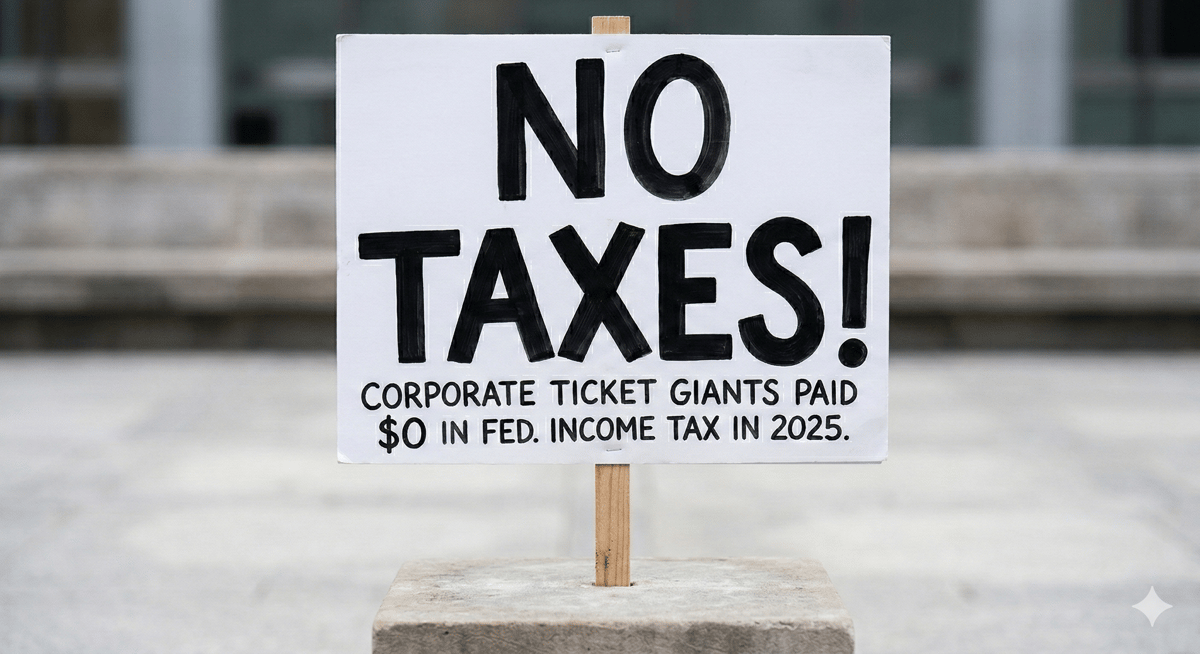
- •Live Nation reported $0 federal tax despite $25.2B revenue.
- •OBBBA provides 100% bonus depreciation for capital‑intensive firms.
- •MSG Entertainment’s spin‑off generated $97M tax benefit.
- •StubHub used $1.4B stock compensation to eliminate tax liability.
- •Zero‑tax advantage fuels venue expansion, widening competitive moat.
Summary
Live Nation, along with other major live‑music firms, reported zero federal income tax for 2025 despite record revenues. The tax outcome stems from the 2025 One, Big, Beautiful Bill Act (OBBBA), which grants 100 % bonus depreciation on new venues, creating paper losses that erase taxable income. Live Nation posted $25.2 billion revenue and $1.3 billion operating income, yet claimed a $0 tax bill by writing off roughly $1 billion of venue construction. Similar strategies allowed MSG Entertainment, StubHub and Vivid Seats to avoid federal taxes.
Pulse Analysis
The One, Big, Beautiful Bill Act, enacted on July 4 2025, introduced permanent 100 % bonus depreciation for qualifying capital assets. For a sector that spends billions on new amphitheaters, arena upgrades and high‑tech club spaces, the law allows firms to deduct the entire construction cost in the year the asset is placed in service. That single provision can generate paper losses large enough to offset operating profits, effectively erasing federal taxable income. Live Nation’s 2025 filing illustrates the effect: $1 billion of venue spend wiped out its $1.3 billion operating income, resulting in a $0 tax bill.
Beyond depreciation, companies are leveraging non‑cash charges to preserve cash. StubHub’s September 2025 IPO triggered a $1.4 billion stock‑based compensation expense, turning a $1.3 billion revenue stream into a reported loss and eliminating its federal tax liability. Vivid Seats relied on goodwill impairments and exited a Tax Receivable Agreement, limiting its cash taxes to a few million dollars. MSG Entertainment’s 2023 spin‑off created net operating loss carryforwards that shield current earnings. These accounting maneuvers convert headline‑grabbing revenues into tax‑free cash, fueling further capital investment.
The tax‑free cash flow creates a feedback loop that strengthens the market dominance of the few large players. With every new venue or upgraded VIP area, firms generate additional depreciation, recycle tax savings into more construction, and widen the gap with independent promoters who lack comparable balance‑sheet resources. While the strategy supports job creation and local economic activity, it also deprives the Treasury of billions in revenue and raises antitrust concerns as barriers to entry rise. Policymakers may revisit the OBBBA’s depreciation rules if the zero‑tax trend threatens competitive balance in the live‑music ecosystem.
Comments
Want to join the conversation?